
A pool villa listing can look simple at first glance. It usually includes photos, a short description, a list of facilities, guest capacity, location details, house rules, and pricing information. But for guests who are close to booking, the way a villa is described can reveal much more than basic features.
A well-written listing helps you understand what the stay will actually feel like. A vague or incomplete listing can create confusion, especially when guests assume that certain facilities, rules, or levels of privacy are included.
This pool villa description guide explains how to read villa listings carefully before booking. It is designed for travelers who want to compare options, avoid misunderstandings, and choose a villa that genuinely fits their trip.
If you are still building your overall decision process, start with the main Pool Villa Guide or the broader Pool Villa Comparison Guide. This article focuses specifically on how to interpret descriptions, listing language, facilities, rules, pricing, photos, and missing details.
What Is a Pool Villa Description Guide?
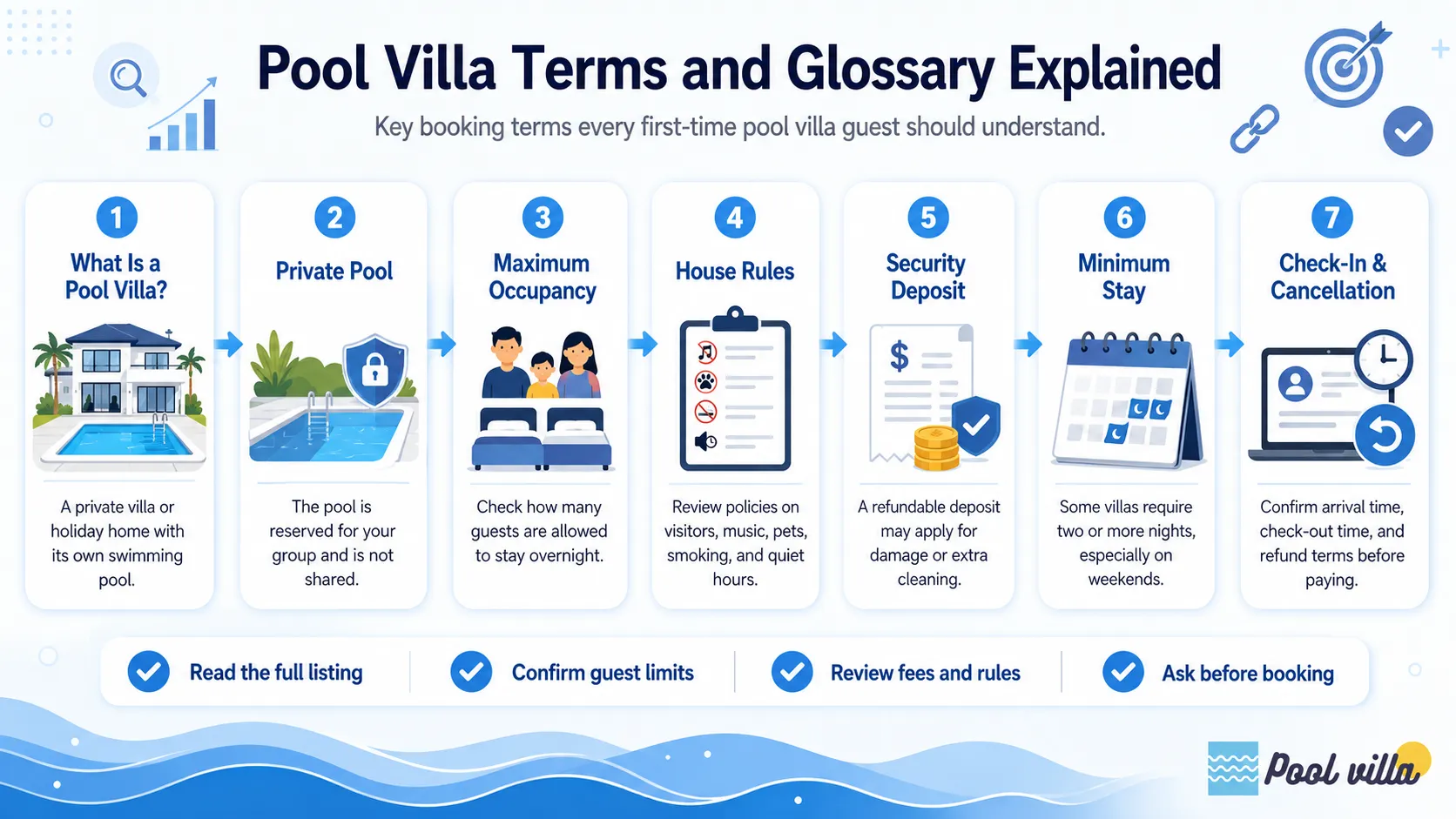
A pool villa description guide is a practical framework for reading and evaluating villa listings before making a booking decision. It helps you understand what the listing says clearly, what it implies, and what you should confirm before paying.
A pool villa description usually includes information about bedrooms, bathrooms, maximum guest capacity, private pool details, kitchen and dining facilities, parking, entertainment features, location, house rules, check-in times, extra charges, and policies for pets, smoking, and parties.
The challenge is that not every listing explains these details with the same level of clarity. Some descriptions are detailed and specific. Others rely on general phrases such as “fully equipped,” “near attractions,” “private area,” or “suitable for groups.”
Those phrases can be useful, but they are not enough on their own. A serious guest should know how to read between the lines and ask the right follow-up questions.
If you are new to this type of accommodation, review What Is a Pool Villa? before using this guide. Understanding the basics will make it easier to evaluate descriptions accurately.
Why Pool Villa Descriptions Matter
Pool villa descriptions matter because they shape expectations before arrival. Guests do not experience the villa directly until check-in, so the listing becomes the main source of information during the decision stage.
A clear description helps guests understand whether the villa is suitable for their group, budget, comfort needs, safety expectations, and stay style. It also reduces the risk of disappointment.
For example, a listing may say the villa is “perfect for groups,” but that does not automatically mean it allows parties, loud music, extra visitors, or late-night karaoke. Another listing may say the villa has a “private pool,” but that does not always explain whether the pool is fully hidden from neighbors, shared visually with nearby properties, or occasionally accessed by staff for maintenance.
This is why villa descriptions are especially important for guests who are actively comparing options. At this stage, users are not only looking for general information. They need trustworthy details that help them make a decision.
From a website structure perspective, this topic supports the wider comparison cluster. It connects naturally to how to compare pool villas, villa photos vs reality, pool villa facilities, privacy expectations, and pool villa rules.
How to Read a Pool Villa Listing
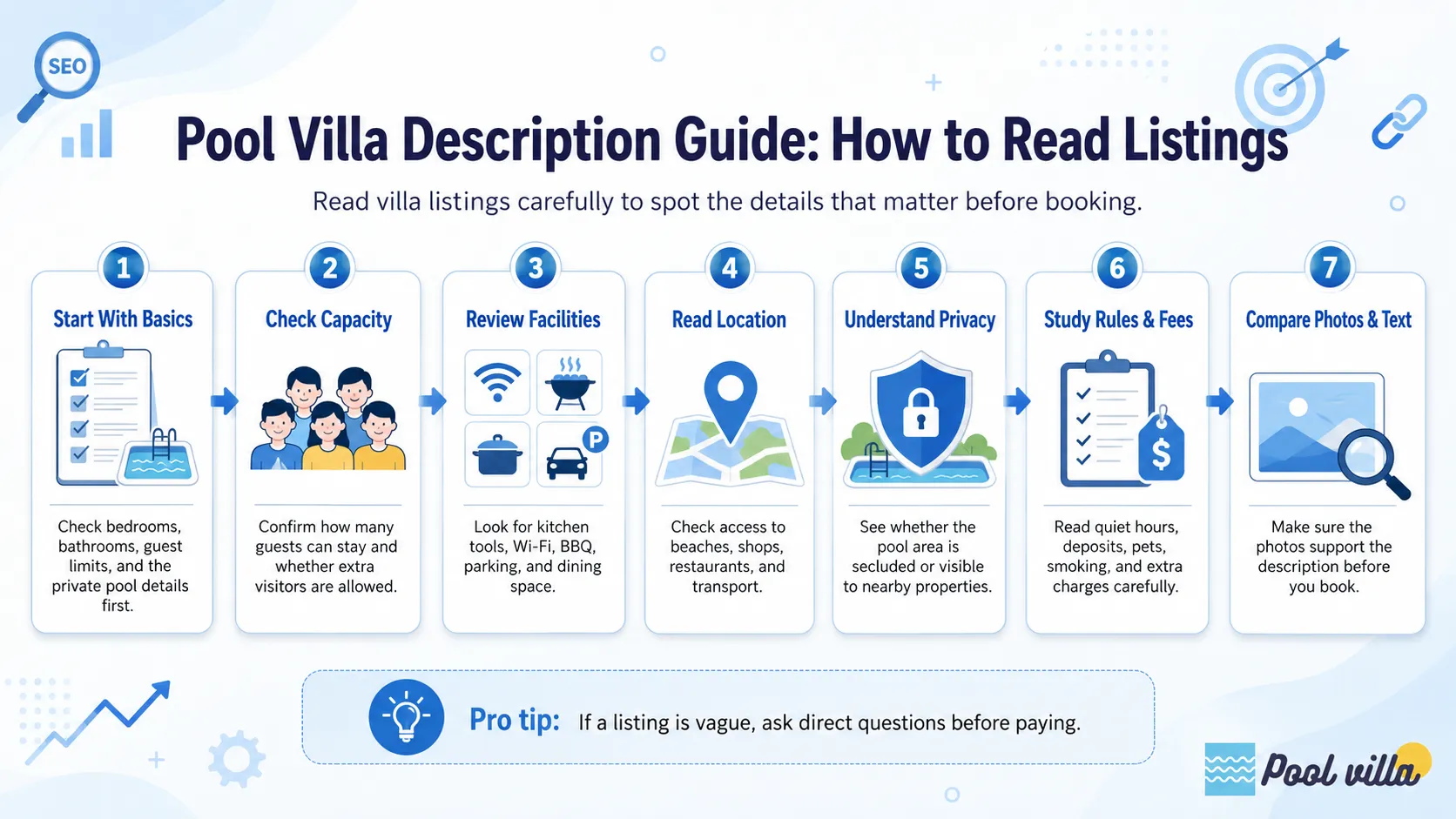
Reading a pool villa listing effectively means reviewing the description in layers. Start with the basic facts, then check whether the details match the photos, rules, pricing, and your trip needs.
A good process is to read the listing in this order:
- Basic property details
- Guest capacity and room layout
- Pool and safety information
- Facilities and amenities
- Location and access
- House rules and restrictions
- Pricing, fees, and deposits
- Photos and missing details
This approach helps you avoid being influenced only by attractive images or promotional wording. It also makes comparison more consistent when reviewing several villas at the same time.
Start With the Facts, Not the Feeling
Many listings use emotional language to make the villa sound relaxing, spacious, private, or luxurious. That language can be helpful, but it should not replace factual details.
Look first for specific information. How many bedrooms are there? How many bathrooms are there? How many guests are allowed? Is the pool private? Is parking available? Is the kitchen suitable for real cooking? Are parties allowed? Is there a security deposit? Are extra guests charged separately?
If the listing gives clear answers, it is easier to compare. If it only gives vague descriptions, you may need to ask the host before booking.
For a more structured booking decision process, use How to Compare Pool Villas Effectively Before Booking alongside this article.
Compare the Description With the Photos
The description and photos should support each other. If the description says the villa has a spacious kitchen, there should be photos showing the kitchen clearly. If the listing says the villa is suitable for large groups, the photos should show enough bedrooms, bathrooms, dining space, seating, and parking.
When a listing emphasizes the pool but does not show bedrooms, bathrooms, kitchen, entrance, or parking, the guest should be cautious. It does not automatically mean the villa is poor quality, but it does mean the listing is incomplete.
For a deeper review of this issue, read Pool Villa Photos vs Reality. That article helps explain how to identify what photos show clearly and what may still need confirmation.
Key Details to Check in a Pool Villa Description
A strong pool villa description should answer practical questions. If it does not, those missing details become important follow-up points before booking.
Guest Capacity
Guest capacity is one of the most important parts of any listing. A description should clearly explain how many guests can stay overnight and whether extra visitors are allowed.
Do not rely only on bedroom count. A villa with four bedrooms may still have a strict maximum occupancy. Some properties also separate overnight guests from daytime visitors.
Look for wording such as maximum guests, extra guest fee, additional mattress, visitors allowed, visitors not allowed, children included in the guest count, or group booking restrictions.
If you are planning a large group stay, review the Pool Villa Large Group Guide and Pool Villa Maximum Occupancy and Extra Guest Rules before confirming.
Bedroom and Bathroom Information
A useful listing should state the number of bedrooms and bathrooms clearly. It should also show whether bathrooms are ensuite or shared, whether bedrooms are on the ground floor, and whether beds are suitable for couples, families, or groups.
Bedroom count alone is not enough. A villa may have several rooms but still feel uncomfortable if the layout is awkward or bathrooms are limited.
Check whether the listing explains bed types, ensuite bathrooms, shared bathrooms, extra mattresses, ground-floor bedrooms, family room arrangements, and privacy between bedrooms.
For more practical guidance, use the Pool Villa Bedroom and Bathroom Count Guide and the Pool Villa Layout Guide.
Private Pool Details
Because the pool is the main feature, the listing should explain more than simply “private pool.”
Useful pool details include pool size, pool depth, shallow areas, children’s suitability, night lighting, pool access, cleaning schedule, pool rules, and jacuzzi or hot tub features if available.
If children, elderly guests, or non-swimmers are joining, pool details matter even more. A beautiful pool is not automatically safe or suitable for every guest.
Before booking, read Pool Safety for Villa Guests, Pool Depth Safety, and Pool Villa Child Safety. If you plan to swim after dark, the Night Swimming Safety guide is also relevant.
Kitchen, BBQ, and Dining Facilities
Many guests choose pool villas because they want to cook, share meals, or enjoy a barbecue. But kitchen facilities vary widely.
A description that says “kitchen included” may mean a full cooking area, or it may mean a basic pantry with limited equipment. The same applies to BBQ facilities. Some villas provide a grill, while others require guests to bring charcoal, gas, utensils, or cleaning supplies.
Check whether the listing mentions a refrigerator, stove, microwave, rice cooker, cooking utensils, plates, glasses, dining table, BBQ grill, outdoor dining area, and cleaning supplies.
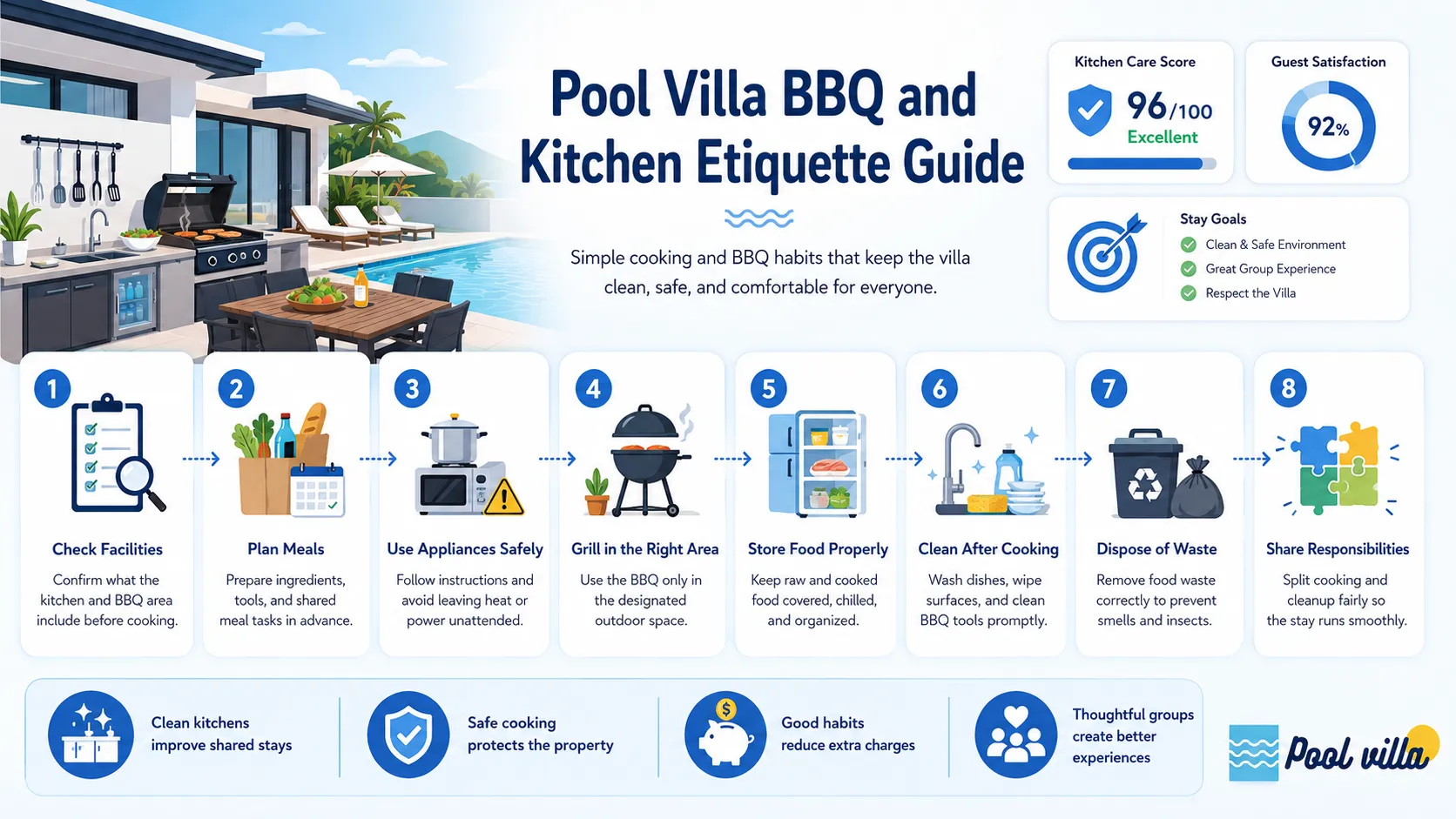
If food planning is important to your stay, read the Pool Villa Kitchen Facilities Guide, Pool Villa BBQ Facilities Guide, and Pool Villa Meal Planning Guide.
Reading Location Descriptions Carefully
Location wording is often one of the most misunderstood parts of a villa listing. Phrases like “near the beach,” “close to attractions,” or “peaceful location” can mean different things depending on the property.
A reliable listing should provide practical location information, not just attractive phrasing.
Look for details such as approximate distance to major places, access road information, parking availability, nearby shops or restaurants, distance to beaches or attractions, transport requirements, food delivery availability, and surrounding neighborhood type.
A villa can be peaceful because it is private and well-located. It can also be peaceful because it is far from shops, restaurants, and transport. Neither is necessarily bad, but guests should understand the trade-off.
If the description is vague, check the map and ask the host for travel details before booking. Location should also be compared with privacy, access, and group convenience. For broader decision support, return to the Pool Villa Comparison Guide.
Understanding Privacy Claims
Privacy is one of the most common selling points in pool villa descriptions. However, the phrase “private villa” can refer to different levels of privacy.
A villa may have a private pool but still be part of a larger villa complex. It may be surrounded by neighboring homes. It may have staff access during the day. It may have a private entrance but shared roads or nearby units.
When reading privacy claims, look for specific details such as fully detached villa, private entrance, enclosed outdoor area, no shared pool, no shared facilities, staff access schedule, neighbor distance, and visibility from nearby buildings.
If privacy is a major reason for booking, do not rely on the word “private” alone. Confirm what is actually private.
For a deeper explanation, read Pool Villa Privacy Explained and Pool Villa Privacy Expectations. These supporting pages help guests understand the difference between a private pool, a private villa, and a fully secluded stay.
How to Read House Rules in a Listing
House rules are not minor details. They determine how guests can use the villa.
A listing should explain rules clearly before booking. If the rules are difficult to find or unclear, ask before making payment.
Pay attention to rules about check-in time, check-out time, quiet hours, maximum occupancy, extra guests, parties, smoking, pets, karaoke, BBQ, pool use, cleaning, damage responsibility, and security deposits.
The rules should match your trip. A villa may look perfect for a celebration, but if parties are not allowed, it is not the right property for that purpose. A villa may look suitable for pets, but if the listing does not clearly allow pets, you should not assume approval.
For more detail, use the Pool Villa Rules and Policies Guide, Common Pool Villa Rules, and Pool Villa Pet Smoking and Party Policy Guide.
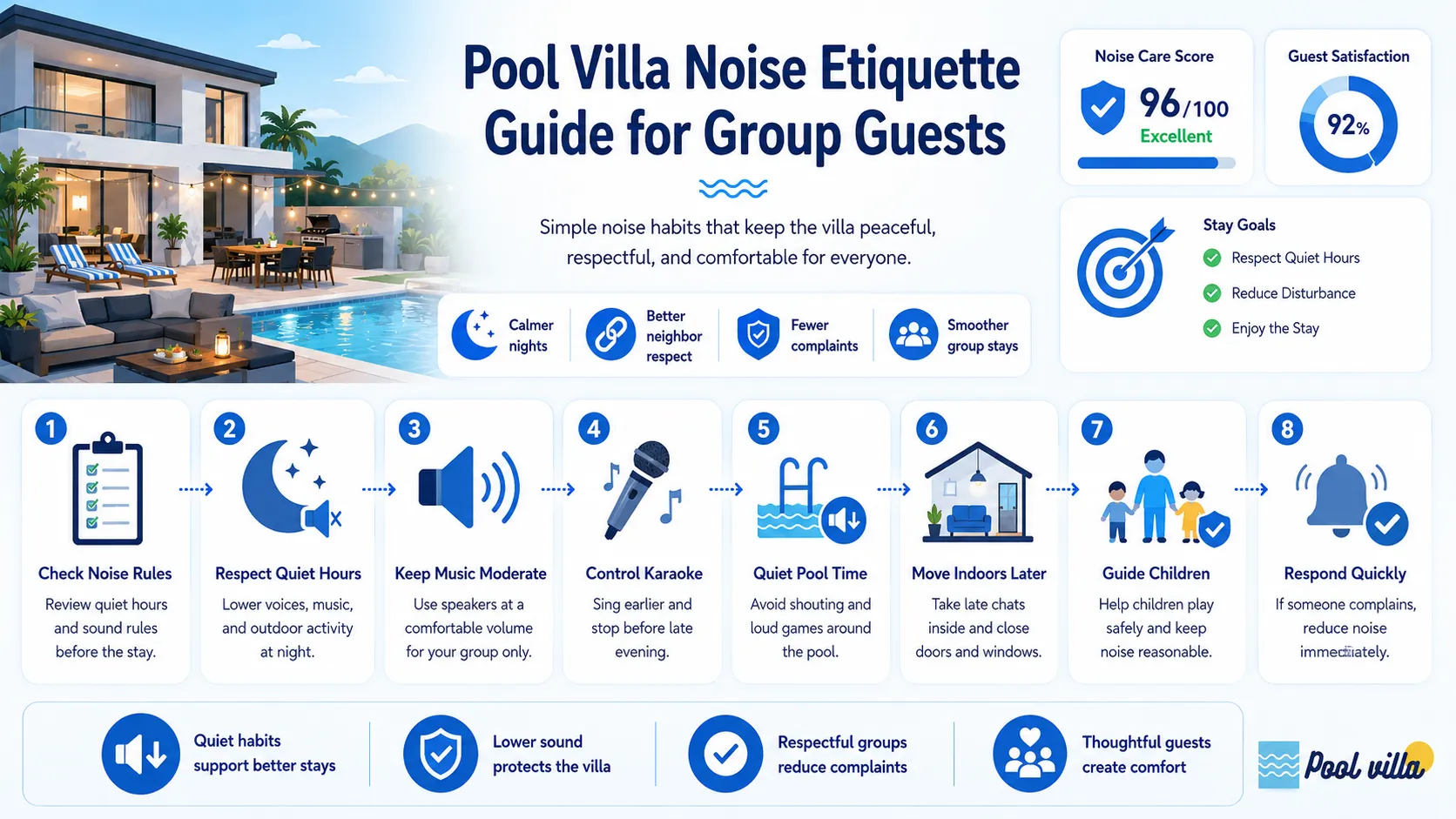
If noise or late-night activities are part of your plan, also review Pool Villa Quiet Hours and Pool Villa Noise Etiquette.
Identifying Vague or Risky Listing Language
Some listing phrases sound helpful but need clarification. These phrases are not necessarily misleading, but they are too broad to rely on without detail.
“Fully Equipped”
This phrase should make you ask: fully equipped for what?
A kitchen may be fully equipped for light cooking but not for preparing meals for a large group. An entertainment area may be fully equipped with a TV and Wi-Fi but not karaoke or streaming services.
Ask for specific equipment if it matters to your stay. The Included Facilities Guide can help you understand what to confirm.
“Suitable for Groups”
This does not always mean parties are allowed. It may only mean the villa has enough bedrooms or shared space.
Check guest limits, quiet hours, visitor rules, and event policies. If your group is large, compare the listing with the Pool Villa Group Stay Planning Guide.
“Near Attractions”
This phrase should be supported by distance or travel time. “Near” could mean a short walk, a short drive, or simply located in the same general area.
If location convenience matters, ask for approximate travel times before booking.
“Private Pool”
This usually means the pool is for your group only, but it does not always mean the pool area is fully hidden from view.
Check visibility, neighboring properties, and staff access. For more context, read Private Pool Villa Meaning Explained.
“Family-Friendly”
A family-friendly villa should still be checked for pool safety, stairs, bathroom access, bedroom layout, and supervision areas.
If you are traveling with children, read Pool Villa With Children Checklist and How to Plan a Pool Villa Stay With Children.
Common Mistakes When Reading Pool Villa Listings
One common mistake is trusting the headline more than the details. A title may highlight luxury, privacy, or group suitability, but the full description may reveal restrictions.
Another mistake is assuming that missing information is automatically included. If the listing does not mention towels, BBQ tools, kitchen equipment, pool depth, or parking, confirm before booking.
Guests also often focus on photos and skip rules. This can lead to problems with noise, extra guests, pets, smoking, or deposits.
Another mistake is overlooking extra charges. A villa may appear affordable, but fees for extra guests, cleaning, utilities, pets, or late check-out can change the total cost. The guide to Pool Villa Extra Charges is useful before making a final decision.
Finally, some guests do not compare listing descriptions consistently. They read one villa carefully and another quickly, then make an uneven decision. If you are comparing several options, use the same criteria for each one.
For a structured comparison process, continue with How to Compare Pool Villas Effectively Before Booking.
Practical Guidance: What to Ask Before Booking
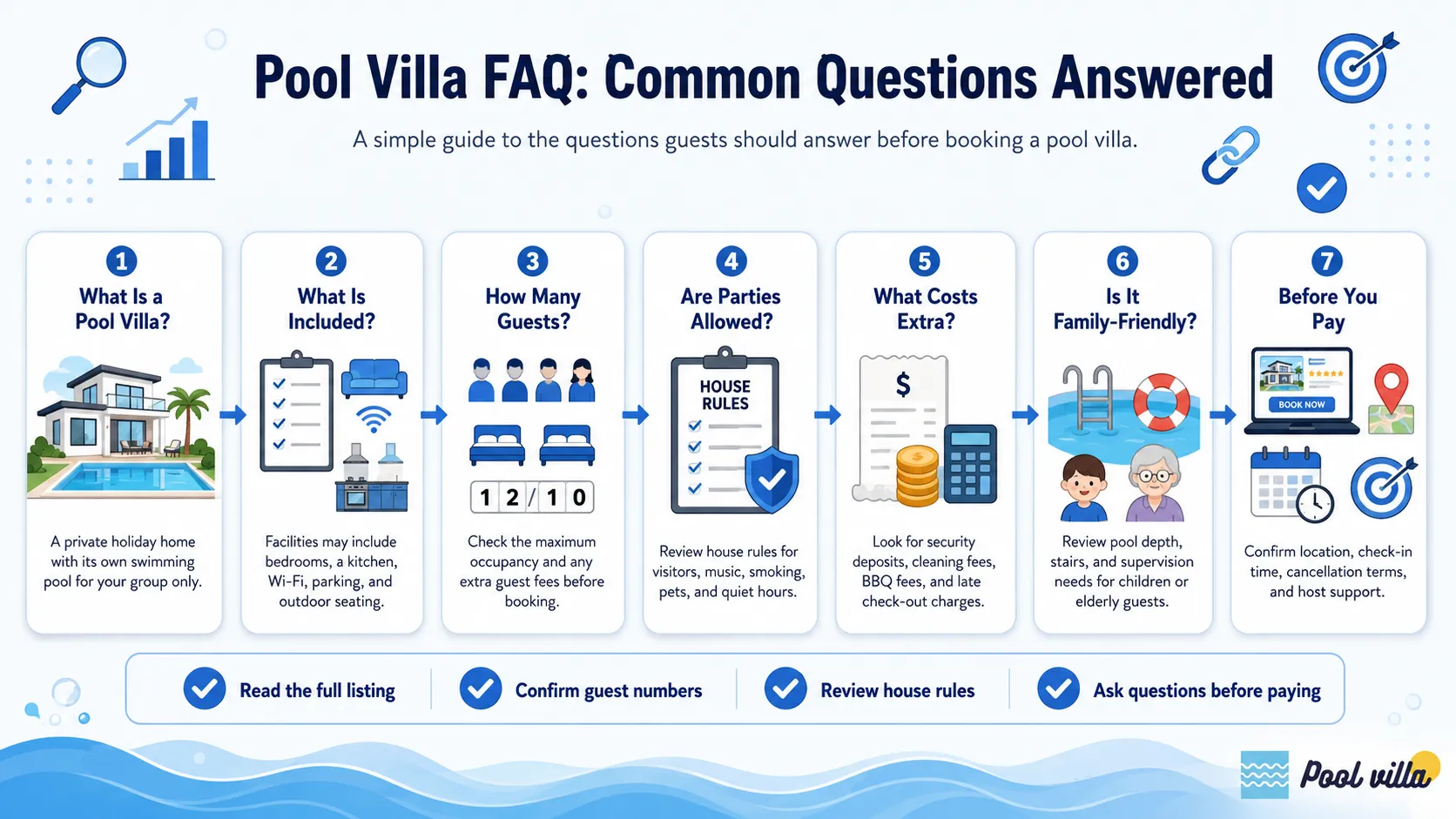
If a pool villa description is unclear, ask direct and practical questions. Good questions help avoid misunderstandings.
Useful questions include:
- What is the maximum number of guests allowed?
- Are extra visitors allowed?
- How many bathrooms are available?
- What are the bed types?
- Is the pool fully private?
- What is the pool depth?
- Is the villa suitable for children?
- What kitchen equipment is included?
- Is BBQ allowed?
- Are pets allowed?
- Are parties or music allowed?
- What are the quiet hours?
- Is parking available?
- Is a security deposit required?
- Are there extra charges?
- What is included in the final price?
These questions are not excessive. They are reasonable before booking an entire private property.
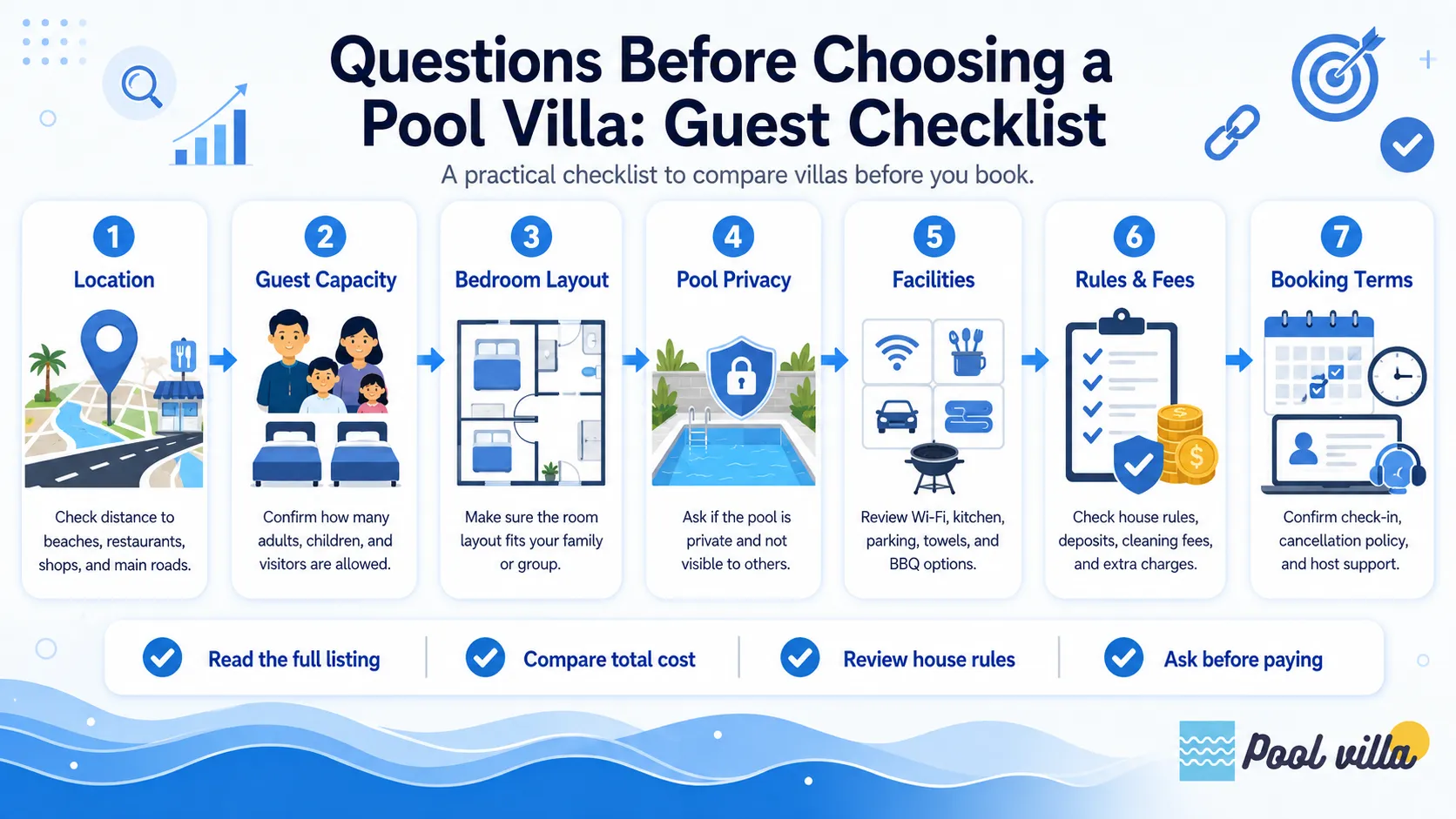
For a full decision checklist, read Questions Before Choosing a Pool Villa and the Pool Villa Stay Checklist.
Timing and Expectations
Reading a villa listing properly takes more time than scanning photos, but it saves time later by reducing confusion.
For a simple couple’s stay, you may only need to confirm privacy, price, pool details, location, and check-in terms. For a family or large group, you should review the description more carefully because more people means more needs, more risk, and more potential misunderstandings.
During peak periods, guests may feel pressure to book quickly. Even then, important details should be confirmed before payment. Availability should not replace due diligence.
A good listing review process includes reading the full description, checking photos, reviewing rules, calculating total cost, asking questions, and comparing the answers with your trip needs.
After booking, use the Pool Villa Arrival Checklist to prepare for check-in and avoid last-minute problems.
Final Pre-Booking Review
Before you book, review the listing one final time with a practical mindset.
Confirm that the villa matches your trip purpose, group size, bedroom needs, bathroom needs, pool safety expectations, privacy requirements, and budget. Check whether the facilities you need are clearly listed. Read the rules carefully, especially if you plan to bring pets, play music, invite visitors, cook, use BBQ facilities, or request flexible check-in and check-out times.
Make sure the total cost is clear. This should include the base rate, extra guest fees, cleaning charges, deposits, utility fees, pet fees, and any optional service charges.
If anything important is unclear, ask before booking. A good listing should make the decision easier, not leave guests guessing.
Conclusion
A pool villa description guide helps guests read listings with more accuracy and confidence. A good listing is more than a collection of attractive photos. It should clearly explain the property, facilities, rules, location, capacity, privacy, pricing, and guest expectations.
When you read descriptions carefully, you can identify what is clear, what is missing, and what needs to be confirmed before booking. This reduces the risk of choosing a villa that looks good online but does not fit your actual stay.
The strongest approach is practical and consistent. Compare listings using the same criteria, confirm important details, and avoid relying on vague phrases. A pool villa should match your group, your purpose, your comfort needs, and your expectations.
For the full decision path, return to the Pool Villa Comparison Guide or continue with Pool Villa Facilities Checklist Before Booking and Pool Villa Photos vs Reality.