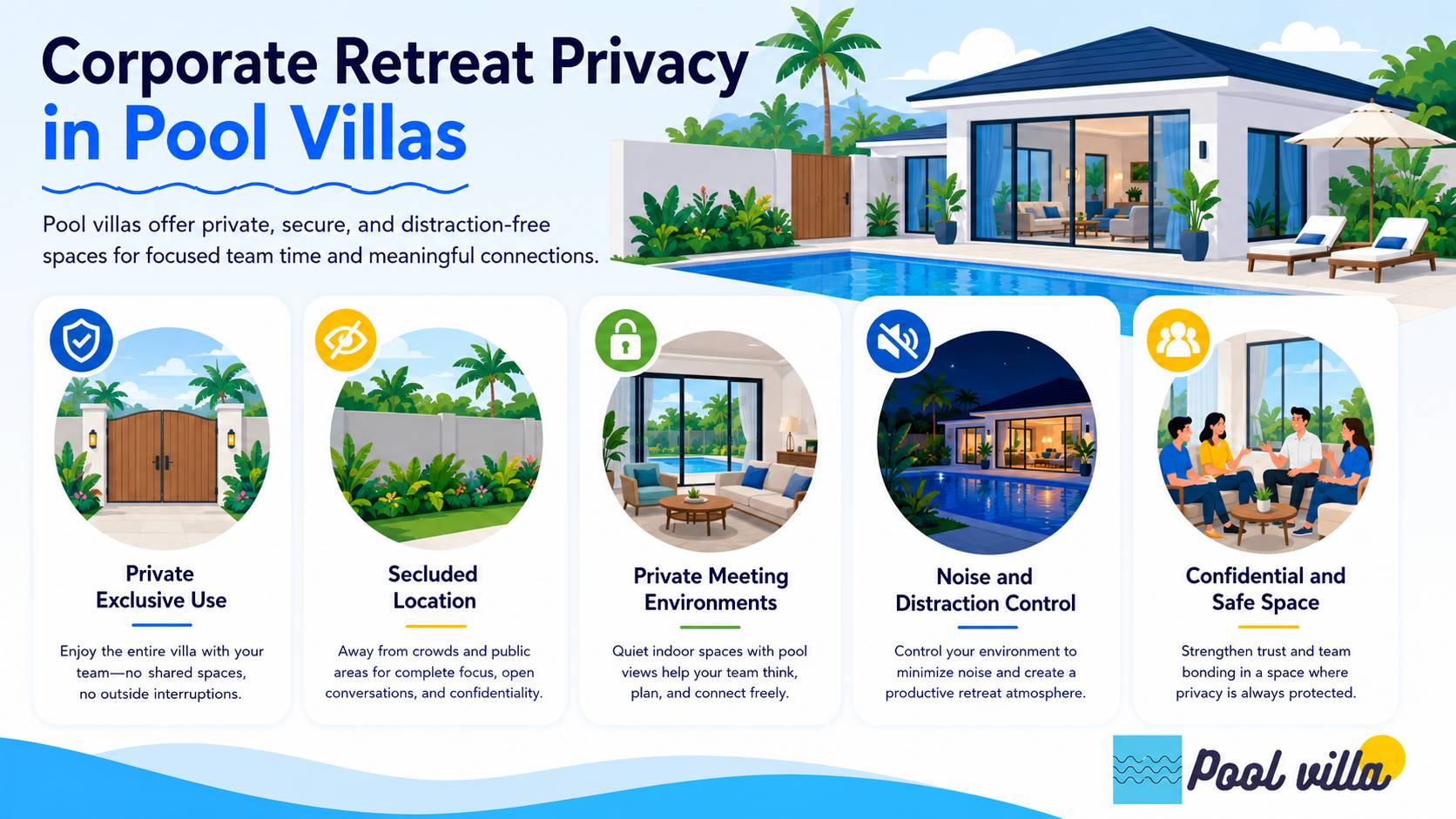
Pool villa corporate retreat privacy is an important part of planning a successful team stay. A private pool villa can be a comfortable setting for workshops, planning sessions, leadership discussions, group meals, and team bonding. However, privacy should not be assumed just because the villa is rented privately.
For corporate retreats, privacy can affect both comfort and professionalism. Teams may need space for confidential conversations, informal discussions, mixed-use activities, private rest time, and group bonding without feeling exposed to neighboring properties, staff access, public roads, or shared areas. A villa may look secluded in photos, but the real privacy level depends on layout, visibility, noise, staff schedules, surrounding buildings, and how the team uses the space.
This guide explains what teams should consider when evaluating privacy in pool villas for corporate retreats, including meeting areas, bedrooms, mixed-use spaces, neighboring properties, group activities, staff access, and common mistakes to avoid.
What Does Pool Villa Corporate Retreat Privacy Mean?
Pool villa corporate retreat privacy means checking whether the villa can support a team retreat without unnecessary exposure, interruption, or discomfort. It includes visual privacy, sound privacy, professional privacy, and personal privacy.
For a team retreat, privacy is not only about the swimming pool. It also includes:
- meeting and discussion areas
- bedrooms and bathrooms
- poolside spaces
- dining areas
- outdoor terraces
- staff access routes
- parking and entrance areas
- neighboring buildings
- shared walkways
- group activity areas
- quiet spaces for rest or private calls
A private pool villa for retreats should help the team feel comfortable using the space for both work and relaxation. It should also protect sensitive conversations when the retreat includes planning, leadership discussions, team feedback, internal issues, or business decisions.
A villa can be beautiful and spacious but still unsuitable if the team feels visible, overheard, or frequently interrupted.
Why Corporate Retreat Privacy Matters
Corporate retreat privacy matters because teams often use retreats for conversations that are more open, strategic, or sensitive than normal daily communication. Even when the retreat is informal, people may discuss company goals, team challenges, project performance, staffing, budgets, client issues, or future plans.
Weak privacy can reduce the value of the retreat. If team members feel overheard, they may speak less openly. If neighboring villas overlook the pool or terrace, the team may not feel relaxed during breaks. If staff enter the property unexpectedly, discussions may be interrupted. If bedrooms or bathrooms lack privacy, participants may feel uncomfortable.
Good corporate retreat privacy supports:
- more focused discussions
- stronger team comfort
- better confidentiality
- relaxed group activities
- smoother mixed-use space planning
- clearer boundaries between work and rest
- better trust during team conversations
- a more professional retreat experience
Privacy does not mean the villa must be isolated. It means the property should match the team’s purpose and comfort needs.
How to Evaluate Privacy Before Booking
Before booking, teams should evaluate privacy based on how the retreat will actually use the villa. A leadership strategy retreat has different privacy needs from a casual team bonding stay. A small executive group may need stronger confidentiality, while a larger team retreat may need more space separation and activity privacy.
Start with these questions:
- Will the team discuss confidential topics?
- Will meetings happen indoors or outdoors?
- Can neighboring properties see the pool or terrace?
- Can conversations be overheard from nearby buildings?
- Will staff enter during the retreat?
- Are bedrooms private enough for colleagues?
- Are bathrooms suitable for professional group use?
- Are any spaces shared with other guests or properties?
- Is there enough separation between activity areas and rest areas?
- Can team members take private calls if needed?
Pool villa corporate retreat privacy should be checked through photos, property details, layout information, and direct questions to the villa host.
Meeting Area Privacy
Meeting area privacy is one of the most important parts of a corporate retreat. Teams may use the villa for workshops, planning sessions, project reviews, or leadership discussions. These sessions often need a space where people can speak comfortably.
Indoor Meeting Privacy
Indoor spaces are usually better for confidential discussions because they offer more control over sound, visibility, and interruptions.
Check whether the meeting area:
- is inside the main villa
- has doors or enough separation
- is away from staff access routes
- is not visible from public areas
- has curtains or blinds if needed
- is quiet enough for discussion
- has enough seating and table space
- is close to bathrooms without being exposed
- allows the team to keep materials private
A dining table or living room can work well for informal meetings if it is private, comfortable, and not too close to exposed outdoor areas.
Outdoor Meeting Privacy
Outdoor spaces can be pleasant for creative discussion or casual reflection, but they are not always suitable for sensitive topics.
Before using an outdoor terrace, poolside area, or garden for meetings, check:
- whether neighboring villas are close
- whether sound carries to nearby properties
- whether staff or other guests pass nearby
- whether the area is visible from higher buildings
- whether road noise affects discussion
- whether the team will feel comfortable speaking openly
Outdoor areas are often best for lighter discussions, breaks, or informal conversations. Use indoor space for confidential or strategic topics.

Privacy From Neighboring Properties
Neighboring properties can strongly affect privacy. A villa may feel private from the inside but still be visible from balconies, hillside villas, upper floors, nearby roads, or adjacent buildings.
What to Check
Before booking, review whether nearby properties can see:
- the pool
- outdoor terrace
- dining area
- meeting area
- bedrooms
- bathrooms
- garden
- entrance
- parking area
This is especially important for corporate retreats because teams may use outdoor spaces for group activities, meals, and informal discussions.
Questions to Ask
Ask the villa host:
- Is the pool area overlooked by nearby properties?
- Are there neighboring villas above the property?
- Can the terrace be seen from other buildings?
- Are there privacy walls, screens, or landscaping?
- Is the dining area fully private?
- Are outdoor meeting areas suitable for team discussions?
A private pool villa for retreats should provide enough separation for the team to feel comfortable, even if it is not completely isolated.
Sound Privacy and Noise Control
Privacy is not only about what others can see. Sound privacy is equally important. Corporate retreat privacy can be affected if conversations are easily heard by neighbors, staff, or other guests nearby.
External Noise
External noise can reduce focus and make conversations difficult. Check for:
- nearby roads
- construction
- nightlife
- restaurants
- neighboring villas
- event venues
- pool equipment
- staff service areas
- barking dogs
- early morning activity
A noisy villa may still be visually private, but it may not support focused retreat discussions.
Conversation Privacy
Teams should also consider whether their own conversations may be heard outside the property. This matters for confidential topics and professional comfort.
Outdoor conversations may carry more than expected. Large group discussions, laughter, evening meals, and team activities may be audible beyond the villa boundary.
A good approach is to use indoor meeting areas for sensitive topics and keep outdoor discussions lighter.
Mixed-Use Space Privacy
Corporate retreats often use the same villa spaces for different purposes. A dining area may become a meeting table. A living room may become a workshop space. A terrace may be used for breaks, meals, and informal bonding. This mixed-use style can work well, but privacy needs to be planned.
Work and Relaxation Boundaries
A team retreat should allow people to shift between work and rest. If every shared space is always used for work, the retreat may feel tiring. If work spaces are too casual, the team may lose focus.
Check whether the villa has:
- a main meeting area
- a separate dining area
- poolside break space
- quiet corners
- private bedrooms
- outdoor seating
- a place for private calls
- enough space for small group discussions
Good mixed-use planning allows the team to meet, eat, relax, and rest without every activity overlapping.
Avoiding Awkward Space Overlap
Privacy problems can happen when spaces overlap too much. For example, a team meeting may happen beside the pool while other participants are resting nearby. A dining area may be used for confidential discussion while staff prepare food nearby. A living room may be too close to bedrooms where some guests are resting.
Pool villa corporate retreat privacy improves when the villa has enough separation between work areas, rest areas, and service areas.
Bedroom and Bathroom Privacy
Bedroom and bathroom privacy is especially important in corporate retreats because colleagues may have different expectations than families or close friends. A room setup that works for a casual friend trip may not feel appropriate for a work retreat.
Bedroom Privacy
Before booking, check:
- number of private bedrooms
- shared room arrangements
- bed types
- door locks
- window coverings
- room distance from shared areas
- room exposure to pool or terrace
- noise from common areas
- whether rooms are suitable for mixed-gender teams
- whether senior staff or facilitators need private rooms
If room sharing is required, it should be communicated clearly before the retreat. Do not assume colleagues are comfortable sharing rooms or beds.
Bathroom Privacy
Bathrooms should also be reviewed carefully.
Check:
- number of bathrooms
- ensuite bathrooms
- shared bathrooms
- bathroom access from bedrooms
- bathroom access from meeting areas
- door locks
- window privacy
- lighting
- ventilation
- whether bathrooms are too exposed to shared areas
Professional comfort depends on these details. A villa with limited bathrooms or open bathroom designs may not be suitable for every team.
Pool and Outdoor Privacy
The pool area is a major part of the villa experience, but it also needs privacy planning. During a corporate retreat, some team members may want to swim, while others may prefer to sit, talk, or rest nearby.
Pool Visibility
Check whether the pool is visible from:
- neighboring villas
- public roads
- staff areas
- shared paths
- higher buildings
- parking areas
If the pool area feels exposed, some team members may avoid using it. This can reduce the value of the villa as a retreat space.
Pool Use and Professional Boundaries
Pool time can be useful for relaxation, but it should be handled thoughtfully. Not every team member will feel comfortable with pool activities in a work-related setting.
A good approach is to make pool time optional and clearly separated from formal retreat sessions. This protects comfort and avoids making participants feel pressured.
Staff, Housekeeping, and Service Access
Staff access can affect privacy during a retreat. Housekeeping, pool cleaning, catering, maintenance, or villa management may need to enter the property. This can be helpful, but the timing should be clear.
What to Clarify
Before booking, ask:
- Is housekeeping included?
- What time does housekeeping enter?
- Can housekeeping be scheduled?
- When is pool cleaning done?
- Will garden staff enter the villa?
- Will catering staff use the kitchen?
- Are staff areas separate from guest areas?
- Can the team request privacy during meeting sessions?
- Who should be contacted if service is needed?
For corporate retreats, service should support the stay without interrupting confidential discussions or team activities.
Best Practice
Schedule staff access around meetings. For example, housekeeping can happen during off-site activities or after workshop sessions. Catering can be timed around meals. Pool maintenance should not happen during planned pool breaks or private discussions nearby.
Privacy for Group Activities
Group activities can include team games, reflection sessions, workshops, poolside conversations, BBQ, shared meals, or informal evening time. These activities require different privacy levels.
Work-Based Activities
Activities involving strategy, feedback, or planning should happen in more private spaces. Indoor rooms are usually better for this.
Social Activities
Social activities may happen outdoors, but the team should still consider visibility and sound. A BBQ or poolside dinner may feel less comfortable if neighboring properties are too close.
Reflection Activities
Reflection sessions may involve more personal or thoughtful discussion. These should feel safe and protected from interruption.
The best pool villa corporate retreat privacy plan matches each activity to the right space.
Privacy and Team Comfort
Privacy is also about how comfortable team members feel with each other. A retreat can blur the line between professional and personal time, so boundaries matter.
Teams should consider:
- optional participation in leisure activities
- private time after sessions
- appropriate room sharing
- clear expectations for pool use
- respectful photography rules
- no pressure around social activities
- quiet areas for people who need rest
- sensitivity to different comfort levels
A retreat works better when people feel they have control over their personal space.
Confidentiality and Work Materials
If the retreat includes business discussions, documents, laptops, presentations, or printed materials, teams should think about information privacy.
Check:
- where laptops will be stored
- whether meeting materials are visible to staff
- whether screens can be seen from outside
- whether confidential papers are left in shared areas
- whether Wi-Fi is secure enough for basic work use
- whether private calls can be taken in separate rooms
For highly sensitive topics, teams should be cautious about where and how discussions happen.
Photography and Social Media Privacy
Corporate retreats often include group photos, but not everyone may want casual villa moments shared online. This is especially relevant when the retreat includes pool areas, informal downtime, or company discussions.
Before the retreat, agree on:
- whether photos are allowed
- which moments are appropriate to capture
- whether pool or leisure photos should be avoided
- whether company discussions should not be photographed
- whether approval is needed before posting
- whether clients, documents, or screens should be kept out of photos
This helps protect both personal privacy and company professionalism.


Location and Privacy Trade-Offs
Location affects privacy. A secluded villa may provide stronger privacy and quietness, but it may be less convenient for transport, food, or activities. A central villa may be easier to access but may have more nearby buildings, road noise, or visible neighbors.
Secluded Villas
Secluded villas may work well for:
- leadership retreats
- strategy sessions
- confidential discussions
- quiet team bonding
- overnight retreats focused on privacy
Potential drawbacks include longer travel time, fewer food options, and harder transport.
Central Villas
Central villas may work well for:
- teams needing easy access
- short retreats
- day meetings
- groups planning outside meals
- teams with varied arrival times
Potential drawbacks include less privacy, more noise, and closer neighbors.
The best choice depends on the retreat purpose.
What to Confirm Before Booking
Before booking, confirm:
- whether meeting areas are private
- whether pool and terrace areas are overlooked
- whether nearby properties are close
- whether outdoor conversations can be heard
- whether staff access can be scheduled
- whether bedrooms are suitable for colleagues
- whether bathrooms provide enough privacy
- whether shared spaces are exclusive to the group
- whether visitors or other guests use nearby facilities
- whether noise rules affect group activities
- whether photography or event use is restricted
- whether the villa supports corporate retreat use
This is the most important stage for checking pool villa corporate retreat privacy.
What to Confirm Before Arrival
Before arrival, confirm:
- room allocation
- meeting schedule
- staff access schedule
- meal and catering timing
- private discussion areas
- pool use expectations
- photography rules
- quiet hours
- house rules
- parking and entrance access
- who manages villa communication
- what areas are used for which activities
A short team briefing before arrival can help everyone understand boundaries and expectations.
Common Mistakes to Avoid
Mistake 1: Assuming Private Rental Means Full Privacy
A villa may be privately rented but still overlooked by neighbors or visited by staff.
Better approach: Check visibility, staff access, and surrounding properties before booking.
Mistake 2: Holding Sensitive Discussions Outdoors
Outdoor spaces may be visible or audible to others.
Better approach: Use indoor spaces for confidential or strategic conversations.
Mistake 3: Ignoring Bedroom Privacy
Colleagues may not be comfortable with casual room sharing or exposed layouts.
Better approach: Confirm rooms, bed types, bathroom access, and privacy before arrival.
Mistake 4: Not Scheduling Staff Access
Unexpected housekeeping or maintenance can interrupt meetings.
Better approach: Agree on service timing before the retreat begins.
Mistake 5: Overlooking Sound Privacy
Noise can travel both ways: from outside into the villa and from the team to neighbors.
Better approach: Consider road noise, neighboring villas, and quiet-hour rules.
Mistake 6: Forgetting Personal Boundaries
A retreat should not pressure everyone into every activity.
Better approach: Keep leisure activities optional and provide quiet spaces.
Practical Tips for Better Corporate Retreat Privacy
Use pool villa corporate retreat privacy checks before booking, not after confirmation.
Choose indoor spaces for sensitive discussions. Outdoor areas are better for breaks, meals, and informal conversation.
Ask about neighboring properties. Privacy walls, landscaping, and distance can make a major difference.
Schedule staff access around meetings. Housekeeping and maintenance should not interrupt important sessions.
Plan room allocation professionally. Colleagues may need more privacy than friends or relatives.
Make pool time optional. Not everyone may want to join leisure activities in a work retreat setting.
Set photo-sharing expectations. Protect both team comfort and company information.
Use quiet zones. Some team members may need rest, calls, or private thinking time.
Match the villa to the retreat purpose. A casual bonding retreat and a confidential leadership retreat need different privacy levels.
When Should Teams Be Extra Careful?
Teams should be extra careful when the retreat includes confidential strategy, leadership discussions, sensitive feedback, budget planning, hiring discussions, client information, or internal company challenges.
Extra care is also needed when:
- the villa is in a dense neighborhood
- outdoor spaces are overlooked
- staff access is frequent
- bedrooms are shared
- bathrooms have open layouts
- the team includes mixed-gender participants
- pool activities are planned
- social media posting is likely
- neighboring villas are close
- noise rules are strict
These situations can still work, but they require clearer planning.
Cost, Time, or Difficulty
Better privacy may increase cost because more private villas often offer larger land, better spacing, stronger landscaping, enclosed outdoor areas, or quieter locations. However, higher price does not always guarantee better privacy. Some expensive villas may still be overlooked if they are in dense villa developments or hillside areas.
Privacy planning takes extra time before booking, but it helps avoid discomfort during the retreat. Teams should ask direct questions about visibility, noise, staff access, room privacy, and meeting areas.
The most important investment is not always money. It is choosing a villa that matches the retreat purpose and setting clear expectations before arrival.
Conclusion
Pool villa corporate retreat privacy is essential for teams that want a retreat to feel comfortable, professional, and useful. Privacy affects meeting quality, team comfort, personal boundaries, group activities, staff interaction, and confidential discussions.
Before booking, teams should check meeting areas, pool visibility, neighboring properties, sound privacy, staff access, bedroom privacy, bathroom setup, outdoor areas, and house rules. A private pool villa for retreats should support both focused work and relaxed downtime without making participants feel exposed or interrupted.
The best corporate retreat privacy plan is practical. Use indoor spaces for sensitive discussions, outdoor spaces for breaks and bonding, and clear communication to protect team comfort throughout the stay.
FAQs
What does pool villa corporate retreat privacy include?
Pool villa corporate retreat privacy includes meeting area privacy, pool and terrace visibility, sound privacy, bedroom and bathroom privacy, staff access, neighboring properties, group activity spaces, and personal comfort during the retreat.
Why is privacy important for corporate retreats in pool villas?
Privacy is important because teams may discuss strategy, planning, feedback, budgets, client topics, or internal issues. A private setting helps people speak more comfortably and keeps the retreat professional.
Are outdoor spaces suitable for private team discussions?
Outdoor spaces can work for light conversations and breaks, but they may not be suitable for confidential topics. Indoor spaces are usually better for strategic or sensitive discussions because they offer more control over sound and visibility.
What should teams ask before booking a private pool villa for retreats?
Teams should ask whether the pool, terrace, meeting areas, bedrooms, and bathrooms are overlooked; whether staff access can be scheduled; whether nearby properties are close; and whether outdoor sound carries to neighbors.
How can teams manage staff access during a retreat?
Teams can ask for housekeeping, pool cleaning, catering, and maintenance to be scheduled around meeting times. Clear service timing helps protect privacy and prevents interruptions.
Should pool activities be included in corporate retreats?
Pool activities can be included as optional downtime or informal bonding. They should not be forced, and teams should consider personal comfort, privacy, photography rules, and professional boundaries.