
Pool villa safety for children should be considered before booking and again after arrival. A private pool villa can be a comfortable choice for families because it offers space, privacy, and flexibility, but it also creates child-related safety responsibilities that are different from staying in a standard hotel room.
A pool villa usually combines indoor rooms, outdoor terraces, stairs, balconies, private pool areas, gardens, kitchens, and bathrooms in one property. For adults, this layout may feel relaxing and convenient. For children, especially toddlers and young swimmers, it can introduce risks if adults do not check the property carefully.
This guide focuses specifically on pool villa safety for children. It does not cover every general villa safety issue in depth. Instead, it explains the child-related areas families should pay attention to, including pool access, supervision, slippery surfaces, doors, stairs, balconies, bedrooms, bathrooms, kitchens, outdoor spaces, and arrival checks.
What Does Pool Villa Safety for Children Mean?
Pool villa safety for children means reviewing how a villa’s layout, pool area, rooms, and shared spaces affect children’s movement, supervision, and comfort. It is not only about the swimming pool. It also includes the paths children use between bedrooms, bathrooms, terraces, kitchens, stairs, and outdoor areas.
A child-safe pool villa should make supervision easier. Adults should be able to understand where children can go, how they can access the pool, whether doors can be secured, and which areas need boundaries or rules.
Important child safety questions include:
- Can children reach the pool without an adult noticing?
- Are pool edges, tiles, or outdoor surfaces slippery?
- Are bedrooms close enough for supervision?
- Are stairs, balconies, or terraces safe for the child’s age?
- Are kitchen items, cleaning products, or appliances within reach?
- Are bathroom floors safe when wet?
- Are outdoor areas enclosed or open to roads?
- Can doors and windows be locked or controlled?
A villa does not need to be perfect to be suitable for families. However, pool villa safety for children depends on knowing which areas need attention and planning around them.
Why Child Safety Matters in Pool Villas
Private pool villas give families more control over their space, but they also remove some of the structure found in hotels or resorts. There may not be lifeguards, shared pool rules, visible staff, or standardized child-safety features. This means families need to take a more active role in checking the property.
Children are naturally curious. They may explore doors, stairs, balconies, pool areas, gardens, bathrooms, and kitchen spaces before adults fully understand the villa layout. This is why the first few minutes after arrival matter.
Pool villa safety for children is especially important when the family includes:
- toddlers
- non-swimmers
- children who move quickly
- children unfamiliar with private pools
- children who wake at night
- siblings playing together near water
- mixed-age groups with different supervision needs
The goal is not to make the stay feel restrictive. The goal is to reduce avoidable risks so families can enjoy the villa more calmly.
How to Approach Pool Villa Safety for Children
The best approach is to review the villa in stages: before booking, on arrival, and throughout the stay.
Before booking, families should check the listing, photos, layout, house rules, and available safety information. This helps avoid villas that clearly do not match the children’s ages or needs.
On arrival, adults should inspect the property before children explore freely. This includes checking pool access, door locks, stairs, balconies, bathroom floors, kitchen hazards, and outdoor boundaries.
During the stay, families should set simple rules and keep supervision consistent. Safety is not a one-time check. Wet floors, open doors, tired children, and changing routines can create new risks throughout the stay.
A good pool villa safety for children approach is practical, not complicated. Parents should focus on the areas where children are most likely to move, play, swim, rest, or explore.
Pool Access and Supervision
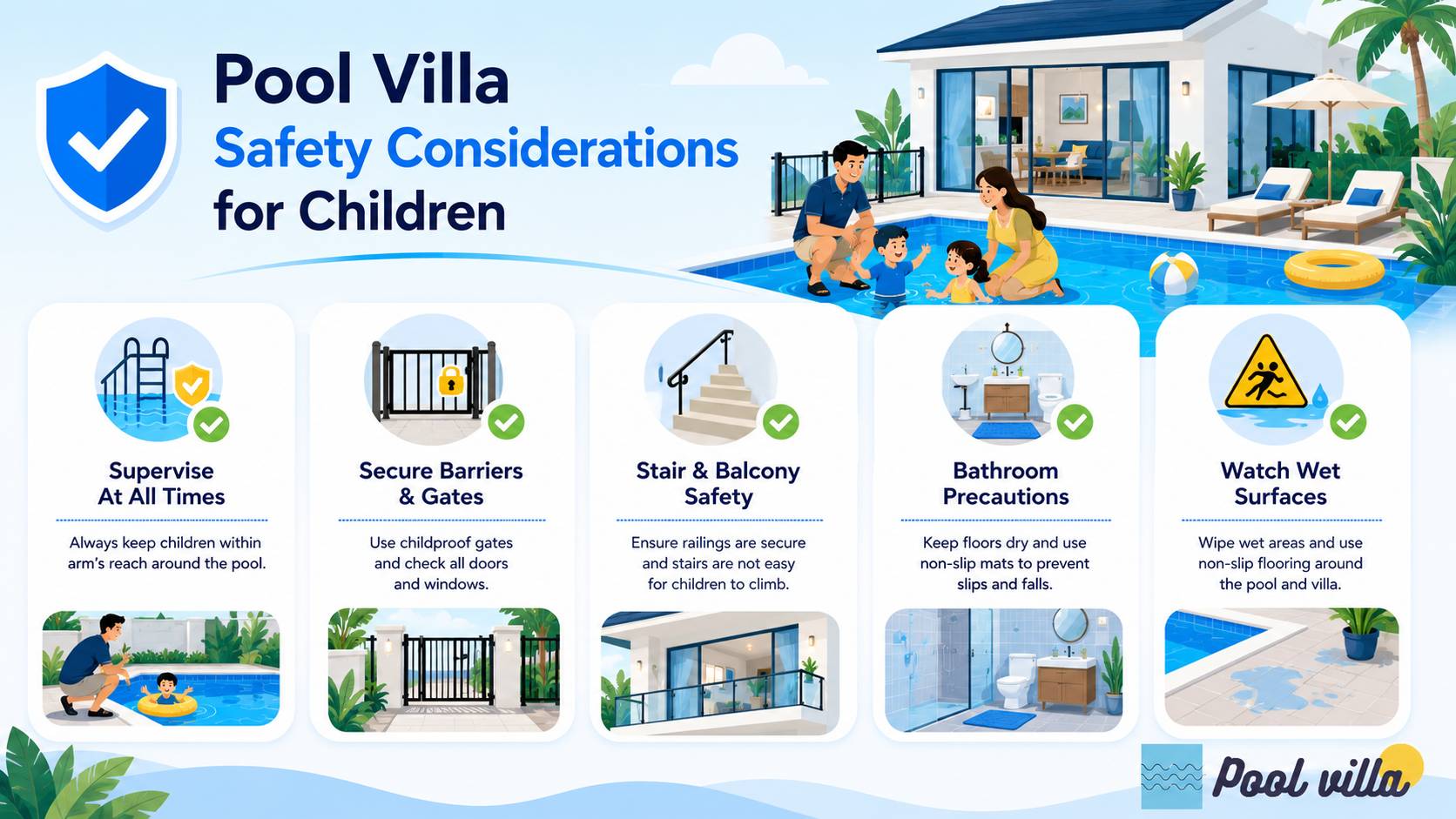
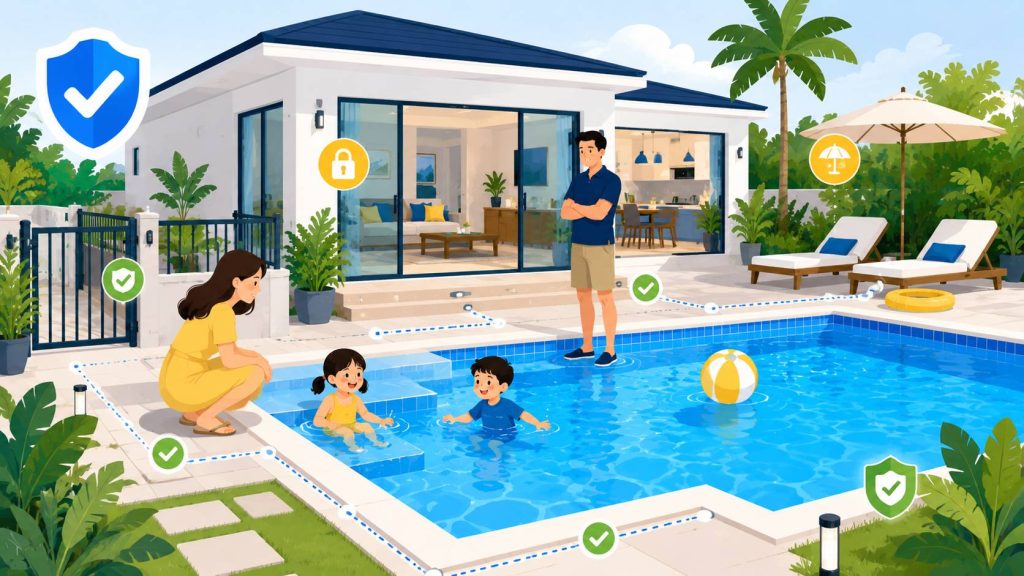
The pool is the most important safety area in any family villa stay. A private pool is enjoyable, but it requires clear adult supervision.
Check How Children Can Reach the Pool
Some villas have pools directly outside the living room. Others have pool-facing bedrooms, open terraces, or sliding doors leading straight to the water. This can be convenient, but families with young children should check whether the pool can be accessed too easily.
Before booking or on arrival, check:
- whether doors to the pool can close securely
- whether children can open pool-facing doors
- whether bedrooms have direct pool access
- whether the pool is visible from the main seating area
- whether outdoor furniture blocks visibility
- whether there are clear walking paths around the pool
- whether the pool area is lit at night
The safest layout is usually one where adults can see the pool clearly and control when children enter the area.
Assign Supervision Clearly
In family groups, supervision can become unclear because several adults may be present. Each person may assume someone else is watching the children.
A simple rule helps: when children are near or in the pool, one adult should know they are responsible at that moment.
This is especially important during group meals, check-in, packing, phone use, or social conversations. Many pool villa safety for children problems happen when adults are nearby but no one is actively supervising.
Slippery Floors and Wet Areas
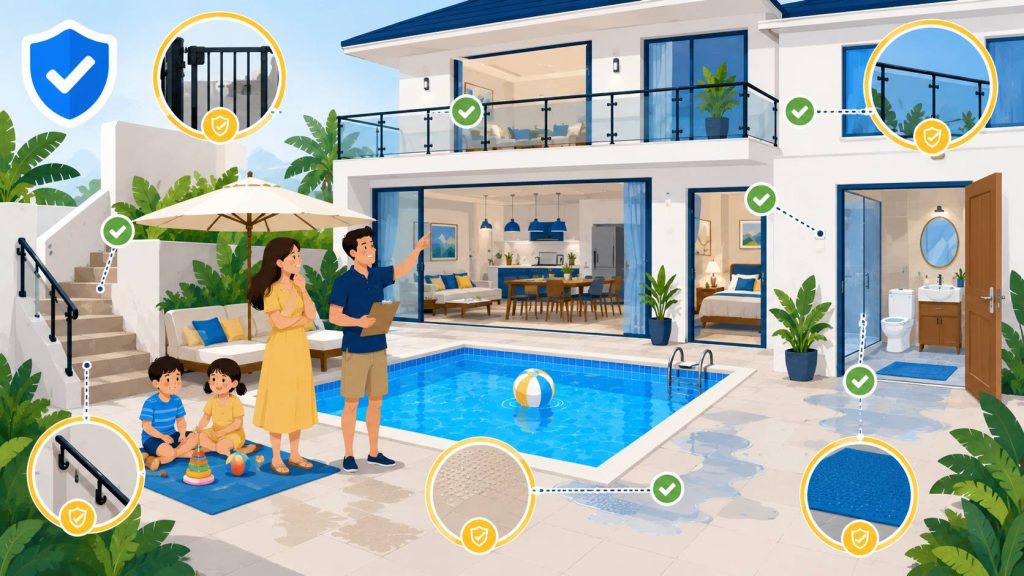
Slippery floors are common in pool villas because children move between the pool, bathrooms, bedrooms, and living areas. Wet feet, smooth tiles, outdoor decking, and bathroom floors can all create slipping risks.
Areas to Check
Pay attention to:
- poolside tiles
- steps into the pool
- outdoor terraces
- bathroom floors
- walkways between pool and bedrooms
- kitchen floors near sinks
- entrance areas after rain
- stairs near outdoor spaces
Even a clean, well-maintained villa can become slippery when children run after swimming.
Better Safety Habits
Families can reduce slipping risks by keeping towels near the pool, reminding children to walk rather than run, drying wet areas quickly, and keeping toys away from walkways.
If the villa has smooth tiles around the pool, adults should be extra careful after rain or evening swims. Good pool villa safety for children includes watching how children move around the pool, not only whether they are in the water.
Stairs, Balconies, and Elevated Areas
Many pool villas have split-level layouts, outdoor stairs, balconies, rooftop terraces, or raised decks. These features may improve views and design, but they need careful review when children are staying.
Stairs
Check whether stairs are steep, slippery, open-sided, or poorly lit. Also check whether toddlers can access stairs without adults noticing.
Families should consider:
- handrails
- stair lighting
- stair width
- outdoor steps after rain
- stairs between bedrooms and bathrooms
- stairs between the living room and pool
For young children, stairs near the pool or bedrooms may require extra rules.
Balconies and Terraces
Balconies should be checked for railing height, gaps, climbable furniture, and easy access from bedrooms. Outdoor furniture should not be placed where children can climb near railings.
Terraces and raised platforms should also be reviewed. Children may not notice height changes when playing or running.
Pool villa safety for children includes checking elevated areas before children begin exploring.
Bedroom Safety for Children
Bedrooms affect child safety because children may wake up, move around, open doors, or look for parents during the night. A bedroom that seems comfortable for adults may not be ideal for young children.
Room Location
Children’s bedrooms should be close enough for parents to respond easily. If bedrooms are on different floors or in separate buildings, parents should decide whether the layout is suitable for the child’s age.
Check:
- distance from parents’ room
- access to bathrooms
- access to pool-facing doors
- balcony doors
- window locks
- stair access from bedrooms
- night lighting
For toddlers or young children, bedrooms with direct pool access may need extra caution.
Sleeping Comfort and Safety
Children sleep better when rooms are quiet, cool, and easy to manage. Families should check air conditioning, curtains, bed height, sharp furniture corners, loose lamps, and electrical outlets.
A child-safe pool villa bedroom does not need special equipment in every case, but it should not create avoidable risks.
Bathroom Safety
Bathrooms are often wet, smooth, and used frequently after swimming. This makes them an important part of pool villa safety for children.
What to Check
Families should check:
- slippery floors
- shower access
- hot water controls
- glass shower doors
- sharp counter edges
- loose mats
- low storage with cleaning products
- nighttime lighting
- bathroom distance from children’s rooms
- bathroom distance from the pool
A bathroom near the pool is convenient, but children may rush in with wet feet. Parents should watch for slippery surfaces and keep towels nearby.
Nighttime Bathroom Use
Children may need to use the bathroom during the night. If the route includes stairs, outdoor walkways, or dark areas, parents should prepare lighting or accompany younger children.
Good pool villa safety for children includes planning for nighttime movement, not only daytime swimming.
Kitchen and Indoor Hazards
Kitchens are useful for families, but they can also contain items that children should not access. Pool villas may have knives, glassware, appliances, cleaning products, hot surfaces, and heavy objects within reach.
Kitchen Safety Checks
On arrival, check:
- where knives are stored
- whether cleaning products are accessible
- whether glass items are stored low
- whether appliances are easy for children to reach
- whether hot surfaces are exposed
- whether cords hang from counters
- whether bins have lids
- whether floors become slippery near the sink
Families with toddlers should move dangerous items out of reach where possible, while respecting the property.
Dining and Snack Areas
Children often gather around kitchens and dining tables. Check whether chairs are stable, table corners are sharp, and children can move safely between the kitchen, dining area, and pool.
Kitchen safety is not the main focus of a villa stay, but it becomes part of daily pool villa safety for children because families use this area often.
Outdoor Spaces and Garden Boundaries
A villa garden, terrace, or yard can be useful for children, but outdoor spaces should be checked before children play there.
What to Check Outdoors
Look for:
- open gates
- gaps in fences
- direct road access
- ponds or water features
- garden tools
- sharp objects
- loose stones
- uneven paths
- insects or pests
- steep drops
- low lighting at night
- parking areas connected to play spaces
A large outdoor area is not automatically child-safe. It should be easy to supervise and clearly separated from roads or risky areas.
Pool and Garden Connection
Some villas have pool areas connected directly to gardens. This can be enjoyable, but families should check whether children can run from garden to pool without supervision.
For young children, the best outdoor areas are enclosed, visible, shaded, and easy for adults to monitor.
Doors, Windows, and Locks
Doors and windows are easy to overlook, but they strongly affect child safety in a private villa. Children may open sliding doors, balcony doors, garden gates, or bedroom doors more easily than adults expect.
What to Check
Check:
- sliding door locks
- balcony door locks
- bedroom door access to the pool
- window locks
- main entrance security
- garden gate locks
- bathroom door safety
- whether doors are heavy or slam easily
- whether glass doors are clearly visible
Glass doors can also be a concern if children run indoors and outdoors. Families should make sure children can see closed glass panels clearly.
A child-safe pool villa should allow adults to control access to important areas, especially the pool, balcony, and road-facing exits.
House Rules and Child Safety
House rules can support safety when families understand them before arrival. Some villas may have rules about pool hours, furniture movement, balcony use, BBQ areas, pets, extra guests, and noise.
Families should check whether the rules match the children’s ages and family routine.
Important rules may include:
- pool use hours
- whether children need adult supervision in certain areas
- whether pool toys are allowed
- whether furniture can be moved
- whether BBQ equipment is safe to use
- quiet hours
- visitor rules
- cleaning expectations
- damage deposits
Rules are not only restrictions. They can help families understand how the property should be used safely and respectfully.
Arrival Safety Walk-Through
One of the most useful steps for pool villa safety for children is a simple arrival walk-through. Before children start swimming or exploring, adults should inspect the villa.
What to Check First
Start with:
- pool access
- door and gate locks
- slippery areas
- stairs
- balconies
- bedroom locations
- bathroom floors
- kitchen hazards
- outdoor boundaries
- lighting
- parking and driveway areas
This does not need to take long. Even ten minutes of checking can help parents identify areas that need rules or supervision.
Set Child Rules Early
After the walk-through, explain simple rules to children based on their age.
Examples include:
- no swimming without an adult
- no running near the pool
- no opening pool doors without permission
- no climbing on balcony furniture
- dry feet before entering bedrooms
- ask an adult before going outside
Clear rules help children understand the villa boundaries from the beginning.
Common Mistakes to Avoid
Mistake 1: Assuming Private Means Safer
A private pool gives families control, but it does not automatically make the pool safer.
Better approach: Check pool access, visibility, locks, flooring, lighting, and supervision rules.
Mistake 2: Letting Children Explore Before Adults Check the Villa
Children may find stairs, balconies, pool doors, or outdoor exits before parents notice them.
Better approach: Do a walk-through first and set basic rules.
Mistake 3: Ignoring Nighttime Movement
A villa may feel safe during the day but become harder to navigate at night.
Better approach: Check lighting, bathroom routes, stairs, and bedroom access after dark.
Mistake 4: Overlooking Slippery Surfaces
Wet floors are one of the most common child-related issues in pool villas.
Better approach: Keep towels nearby, dry wet areas, and remind children not to run.
Mistake 5: Choosing a Villa That Does Not Match the Child’s Age
A villa suitable for teenagers may not be suitable for toddlers.
Better approach: Choose based on the youngest or least independent child.
Practical Tips for Better Pool Villa Safety for Children
Choose the villa based on the child’s age and swimming ability. Younger children need closer supervision and better access control.
Ask about the pool layout before booking. Find out whether children can reach the pool directly from bedrooms or living areas.
Check door locks immediately after arrival. Pool-facing doors, balcony doors, and garden gates should be reviewed first.
Keep wet and dry areas organized. Towels, sandals, and dry paths help reduce slipping.
Assign pool supervision clearly. One adult should always know when they are responsible for watching children near the pool.
Use bedrooms wisely. Place young children close to parents and away from direct pool access if possible.
Check lighting before evening. Stairs, bathrooms, pool edges, and outdoor walkways should be visible after dark.
Review rules with children in simple language. Children should know which areas need adult permission.
When Should Families Be Extra Careful?
Families should be extra careful when the villa has direct pool access from bedrooms, open terraces, split-level layouts, balconies, outdoor staircases, or unfenced garden areas.
Extra care is also needed for toddlers, non-swimmers, children who are very active, and children who are not used to private pools. These children may explore quickly and may not recognize risks.
Families should be especially careful during arrival, meal times, group conversations, packing, and check-out. These are moments when adults may be distracted and children may move around more freely.
Pool villa safety for children depends on consistent attention, not only the villa design.
Cost, Time, or Difficulty
Improving child safety in a pool villa does not always require extra cost. Many safety steps involve checking the property, setting rules, and supervising clearly.
However, safer villa choices may sometimes cost more. A villa with a simpler layout, better pool visibility, more suitable bedrooms, safer flooring, and convenient bathroom access may be more valuable for families than a cheaper villa with riskier design.
Families may also spend more time asking questions before booking. This is usually worthwhile because child-related safety issues can affect the whole stay.
The easiest approach is to focus on the highest-impact areas: pool access, stairs, balconies, slippery floors, bedrooms, bathrooms, and outdoor boundaries.
Conclusion
Pool villa safety for children is about understanding how children move through the villa and where supervision is most important. The private pool is the main concern, but families should also check stairs, balconies, bathrooms, bedrooms, kitchens, outdoor spaces, doors, windows, and lighting.
A child-safe pool villa is not necessarily the most expensive or most luxurious property. It is the villa where adults can supervise children more easily, control access to risky areas, and support safe daily routines.
Before booking, families should ask practical questions about layout and pool access. After arrival, they should complete a quick safety walk-through and set clear rules for children. With the right attention, a pool villa stay can be safer, calmer, and more enjoyable for the whole family.
FAQs
What is the most important part of pool villa safety for children?
The most important part of pool villa safety for children is controlling pool access and supervising children clearly. Families should check whether children can reach the pool unsupervised, whether adults can see the pool easily, and whether doors or gates can be secured.
Is a private pool villa safe for children?
A private pool villa can be safe for children when the layout supports supervision and adults manage pool access carefully. Families should check slippery surfaces, stairs, balconies, doors, bedroom locations, and outdoor boundaries before allowing children to explore freely.
What should parents check first after arriving at a pool villa?
Parents should first check pool access, door locks, stairs, balconies, slippery floors, bathroom safety, kitchen hazards, outdoor gates, and lighting. A short arrival walk-through helps identify areas that need rules or closer supervision.
Are pool-facing bedrooms safe for children?
Pool-facing bedrooms can be convenient, but they require caution for young children. Families should check whether doors lock securely, whether children can open them, and whether the pool can be reached without adult supervision.
How can families reduce slipping risks around a villa pool?
Families can reduce slipping risks by keeping towels near the pool, drying wet areas, reminding children to walk, checking outdoor flooring, and keeping toys away from walkways. Bathrooms and indoor floors near the pool should also be checked.
What makes a child-safe pool villa?
A child-safe pool villa has manageable pool access, visible shared areas, secure doors, safe stairs, suitable bedrooms, practical bathrooms, non-slippery surfaces, clear outdoor boundaries, and a layout that allows adults to supervise children easily.