
Planning accommodation for a group of 20 people is rarely as simple as counting beds. In large pool villas, the number of bedrooms affects privacy, sleeping comfort, bathroom access, noise levels, and the overall group experience.
Many travelers assume that a villa advertised for 20 guests automatically provides comfortable sleeping arrangements for everyone. In reality, some properties technically fit 20 people by using sofa beds, extra mattresses, or shared sleeping areas that may not work well for families, couples, or adult groups.
Understanding realistic bedroom planning helps avoid overcrowding, poor sleep quality, and group frustration during the stay. Whether the trip involves friends, extended family, corporate retreats, or celebrations, choosing the right bedroom setup is one of the most important parts of booking a large pool villa.
This guide explains how to evaluate bedrooms for 20 people pool villa stays in a practical and realistic way.
What Does Bedrooms for 20 People Pool Villa Mean?
The phrase “bedrooms for 20 people pool villa” refers to how many private sleeping rooms are realistically needed to accommodate a group of 20 guests comfortably.
This does not simply mean placing 20 people inside a property. It involves balancing:
- Bed capacity
- Bedroom privacy
- Guest relationships
- Shared sleeping tolerance
- Bathroom access
- Noise management
- Personal comfort
A villa may legally or technically host 20 people, but that does not guarantee a practical sleeping arrangement.
For example:
- A 5-bedroom villa with multiple bunk beds may technically fit 20 guests
- A 7-bedroom villa may offer significantly more comfort and privacy
- An 8-bedroom villa may be ideal for mixed-age family groups or corporate stays
The “correct” number of bedrooms depends heavily on the type of group using the property.
Why Does Bedroom Planning Matter?
Bedroom planning directly affects the quality of the trip.
Poor room allocation creates problems that become more noticeable after the first night. Large groups usually spend long days together, so sleep quality and personal space become extremely important.
Privacy and Comfort
Adult guests usually expect some level of privacy, especially during multi-night stays.
Couples often prefer private rooms. Families may need separate areas for children. Older guests may struggle with noisy shared sleeping spaces.
When too many people share one bedroom, common issues include:
- Lack of personal space
- Noise disturbances
- Different sleeping schedules
- Air conditioning conflicts
- Storage limitations
- Reduced sleep quality
These problems become more serious in tropical destinations where guests spend substantial time inside the villa.
Bathroom Access
Bedroom count often connects closely to bathroom availability.
A villa may advertise 20-person capacity but only provide four bathrooms. This creates delays during mornings, pool use, showers, and evening preparation.
For large groups, comfortable bathroom planning usually matters almost as much as bedroom count itself.
Group Dynamics
Different group types require different sleeping strategies.
For example:
- Families with children often tolerate shared rooms better
- Adult couples usually prefer private bedrooms
- Corporate groups typically require more privacy
- Mixed-age groups benefit from quieter room separation
A villa suitable for 20 university friends may not work well for a multi-generational family vacation.
How Many Bedrooms Do 20 People Realistically Need?
There is no single perfect answer, but realistic planning usually falls within a certain range.
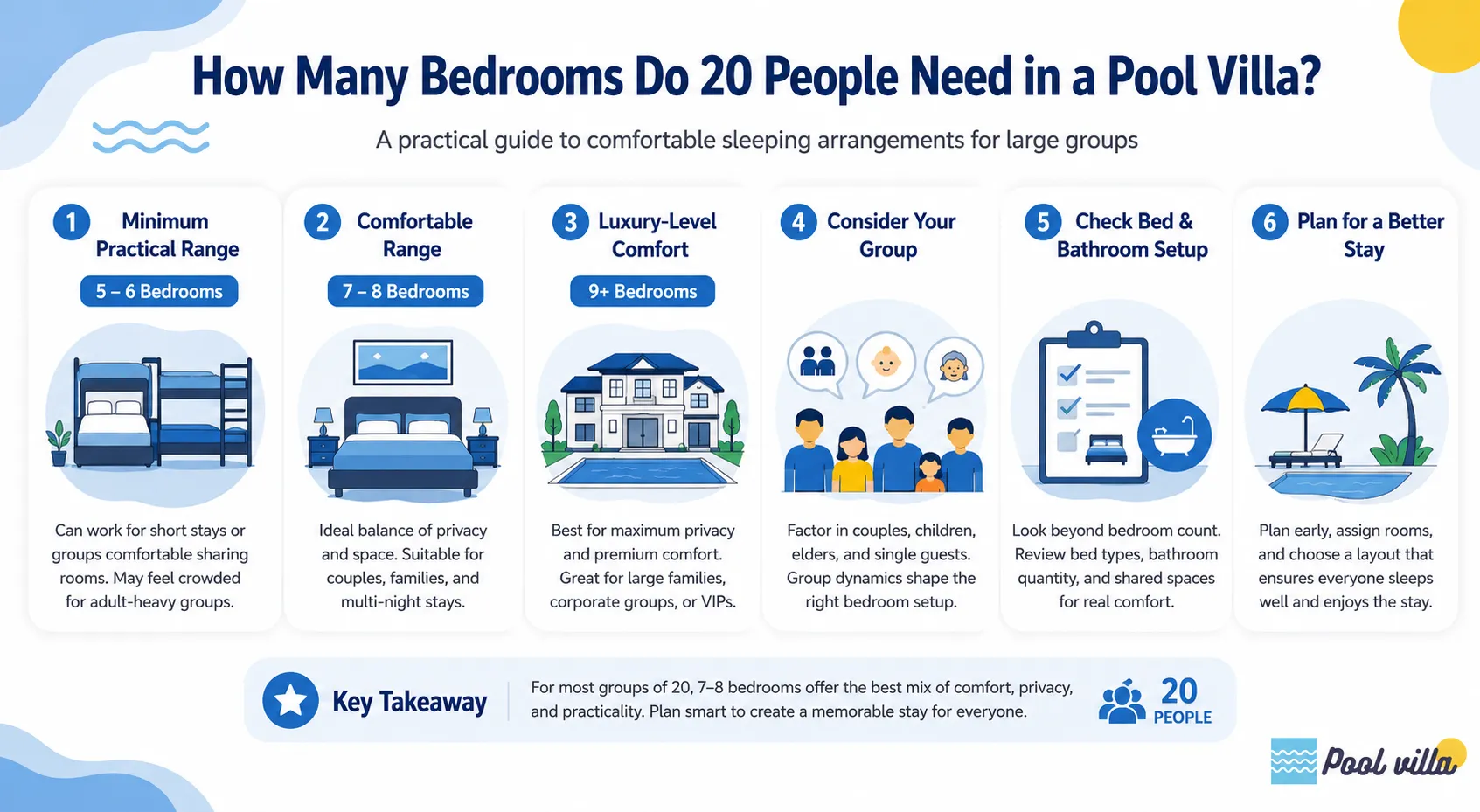
Minimum Practical Range: 5 to 6 Bedrooms
A 5-bedroom villa can sometimes work for 20 people if:
- Guests are comfortable sharing rooms
- Several rooms contain multiple beds
- Children are included in the group
- The stay is short-term
- Privacy expectations are low
Typical setups may include:
- Double beds plus bunk beds
- Shared family rooms
- Extra floor mattresses
- Convertible sofa beds
However, this arrangement can feel crowded for adult-heavy groups.
A 6-bedroom villa generally provides a more balanced setup while still maximizing occupancy.
Comfortable Range: 7 to 8 Bedrooms
For most adult groups, 7 to 8 bedrooms is a far more comfortable option.
This setup usually allows:
- Couples to have private rooms
- Families to stay together
- Reduced noise issues
- Better luggage storage
- More personal space
- Improved sleep quality
This range works especially well for:
- Family reunions
- Wedding groups
- Company retreats
- Long weekend stays
- Luxury vacations
The overall experience tends to feel significantly more relaxed compared to highly compressed sleeping arrangements.
Luxury-Level Comfort: 9+ Bedrooms
Large luxury pool villas sometimes offer 9 to 12 bedrooms for groups of 20.
This level of space provides:
- Near hotel-level privacy
- Flexible room assignments
- Quiet sleeping conditions
- Better separation between adults and children
- More comfortable long-term stays
These villas are especially useful when:
- Guests do not know each other well
- The trip lasts several days
- Multiple families are traveling together
- VIP comfort is important
While more expensive, the added comfort can greatly improve the group experience.
How Should You Approach Bedroom Planning?
The best approach starts with understanding the group itself, not just the guest count.
Step 1: Identify Group Structure
Start by categorizing the guests.
Ask practical questions such as:
- How many couples are there?
- How many children?
- Are there elderly guests?
- Are guests comfortable sharing rooms?
- Are there single travelers?
- Does anyone require quiet sleeping conditions?
These details heavily influence room planning.
Step 2: Separate Adults and Children
Children usually adapt more easily to shared sleeping arrangements than adults.
A common strategy includes:
- Parents in private rooms
- Children sharing bunk rooms
- Teenagers grouped together
- Single adults sharing twin rooms
This approach reduces overall bedroom pressure while maintaining comfort.
Step 3: Check Actual Bed Types
Never rely only on the bedroom count.
A “7-bedroom villa” can vary dramatically depending on the bed configuration.
Important details include:
- King beds
- Queen beds
- Twin beds
- Bunk beds
- Sofa beds
- Floor mattresses
- Extra rollaway beds
Two villas with the same bedroom count may provide completely different sleeping experiences.
Step 4: Evaluate Shared Spaces
Large groups also spend time outside bedrooms.
Check whether the villa provides:
- Large dining tables
- Multiple seating areas
- Outdoor relaxation space
- Separate quiet zones
- Enough poolside seating
Overcrowding often becomes worse when common areas are too small for the group size.
What Bedroom Layouts Work Best for 20 Guests?
Certain layouts work more efficiently for large groups.
Multi-Master Bedroom Layouts
Villas with several large master bedrooms are ideal for:
- Couples
- Parents
- Older guests
- Group organizers
This reduces conflict over room assignments.
Family Suite Configurations
Family suites combine:
- One large bed
- Additional twin beds or bunk beds
- Shared bathrooms
These work particularly well for families with younger children.
Mixed Private and Shared Rooms
One of the most practical solutions combines:
- Private couple rooms
- Shared twin rooms
- Bunk rooms for younger guests
This balances comfort and budget more effectively than trying to make every room fully private.
Common Mistakes
Large group villa bookings often fail because people focus only on price or occupancy numbers.
Assuming Capacity Equals Comfort
A villa advertised for 20 guests may technically fit 20 people but still feel overcrowded.
Always evaluate:
- Bedroom count
- Bed arrangement
- Bathroom ratio
- Living space size
Not just the maximum occupancy.
Ignoring Bathroom Distribution
Some villas place too many guests around a single bathroom area.
This creates traffic problems during mornings and evenings.
Ideally, large villas should provide:
- Multiple ensuite bathrooms
- Additional guest bathrooms
- Outdoor shower access near the pool
Overlooking Noise Separation
Pool villas often have open layouts that amplify sound.
Guests sleeping near:
- Pool areas
- Living rooms
- Karaoke rooms
- Outdoor seating
may experience sleep disruption.
This becomes particularly important for children and older adults.
Relying Too Heavily on Extra Beds
Temporary mattresses and sofa beds may work for one night, but they become uncomfortable during longer stays.
For multi-night trips, permanent bed setups are usually far more practical.
Practical Tips for Better Results
Choosing the right villa becomes easier when you evaluate the property like a real sleeping environment instead of a marketing listing.
Prioritize Bed Quality Over Maximum Capacity
A slightly smaller guest capacity with proper beds often creates a much better experience than squeezing everyone into temporary sleeping spaces.
Request a Full Sleeping Layout
Before booking, ask for:
- Bedroom photos
- Bed configuration details
- Floor plans
- Bathroom count
- Extra bed policies
This helps avoid surprises after arrival.
Consider Stay Duration
The longer the stay, the more important bedroom comfort becomes.
A compressed arrangement may work for:
- One-night celebrations
- Weekend trips
- Short gatherings
But longer vacations usually require more personal space.
Plan Room Assignments Early
For large groups, assigning rooms before arrival prevents confusion and conflict.
Many organizers use simple categories:
- Couples first
- Families second
- Singles afterward
This creates a more organized check-in process.
When Should You Be Extra Careful?
Some situations require additional planning attention.
Mixed-Age Family Trips
Grandparents, toddlers, and teenagers all have different sleep needs.
Careful room separation helps reduce:
- Nighttime disturbances
- Early morning noise
- Bathroom congestion
Corporate Retreats
Work-related trips usually require higher privacy standards.
Employees may feel uncomfortable sharing crowded sleeping spaces with colleagues.
More bedrooms often improve professionalism and overall satisfaction.
Luxury Group Travel
High-budget travelers generally expect:
- Private rooms
- Ensuite bathrooms
- Comfortable bedding
- Quiet sleeping conditions
Overcrowded layouts can significantly reduce the perceived value of the property.
Multi-Night Stays
The longer the trip lasts, the more noticeable poor room planning becomes.
Small inconveniences often grow into major frustrations after several days.
FAQ
Is a 5-bedroom pool villa enough for 20 people?
It can work in some situations, especially for younger groups or short stays, but it may feel crowded for adult-heavy groups or longer vacations.
What is the ideal number of bathrooms for 20 guests?
Most comfortable large-group villas provide at least 6 to 8 bathrooms. Fewer bathrooms often create congestion during busy hours.
Are bunk beds suitable for adult guests?
Bunk beds can work for younger adults or short stays, but they are usually less comfortable than standard beds for multi-night trips.
Should couples always have private bedrooms?
For comfort and privacy, private bedrooms are usually preferred for couples, especially during longer stays.
Is it better to book a larger villa than necessary?
In many cases, yes. Slightly extra space often improves sleep quality, privacy, and the overall group experience.
Conclusion
Choosing the right bedrooms for 20 people pool villa accommodation involves far more than matching guest count to advertised capacity. Real comfort depends on bedroom layout, bed types, bathroom access, privacy expectations, and the overall structure of the group.
For most adult groups, 7 to 8 bedrooms usually provide the best balance between comfort and practicality. Smaller setups may technically fit 20 guests, but they often require compromises that reduce sleep quality and personal space.
The most successful large-group villa stays come from realistic planning rather than maximizing occupancy numbers. Evaluating the actual sleeping arrangement carefully before booking helps prevent overcrowding, reduces group stress, and creates a far more enjoyable experience for everyone involved.