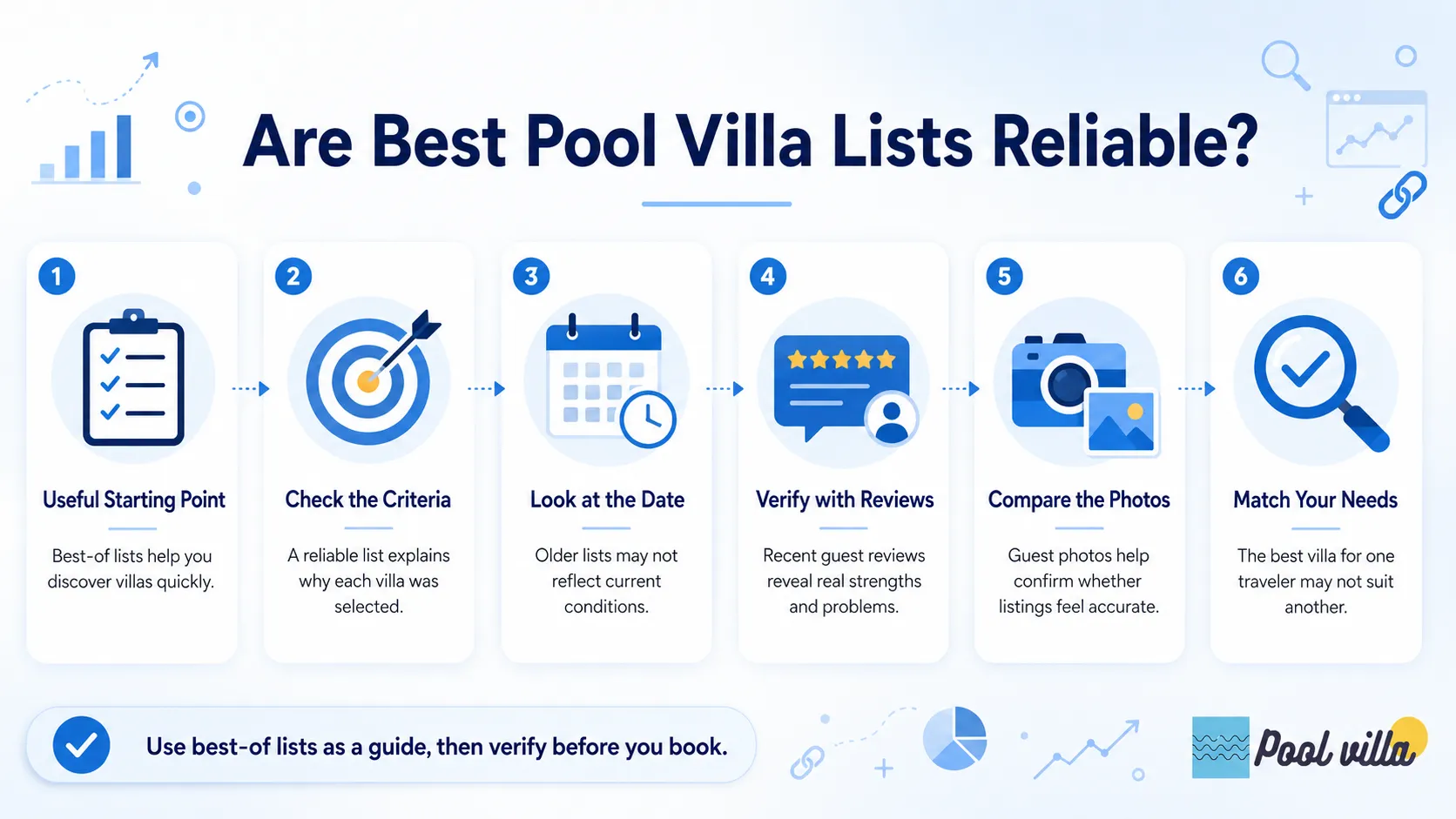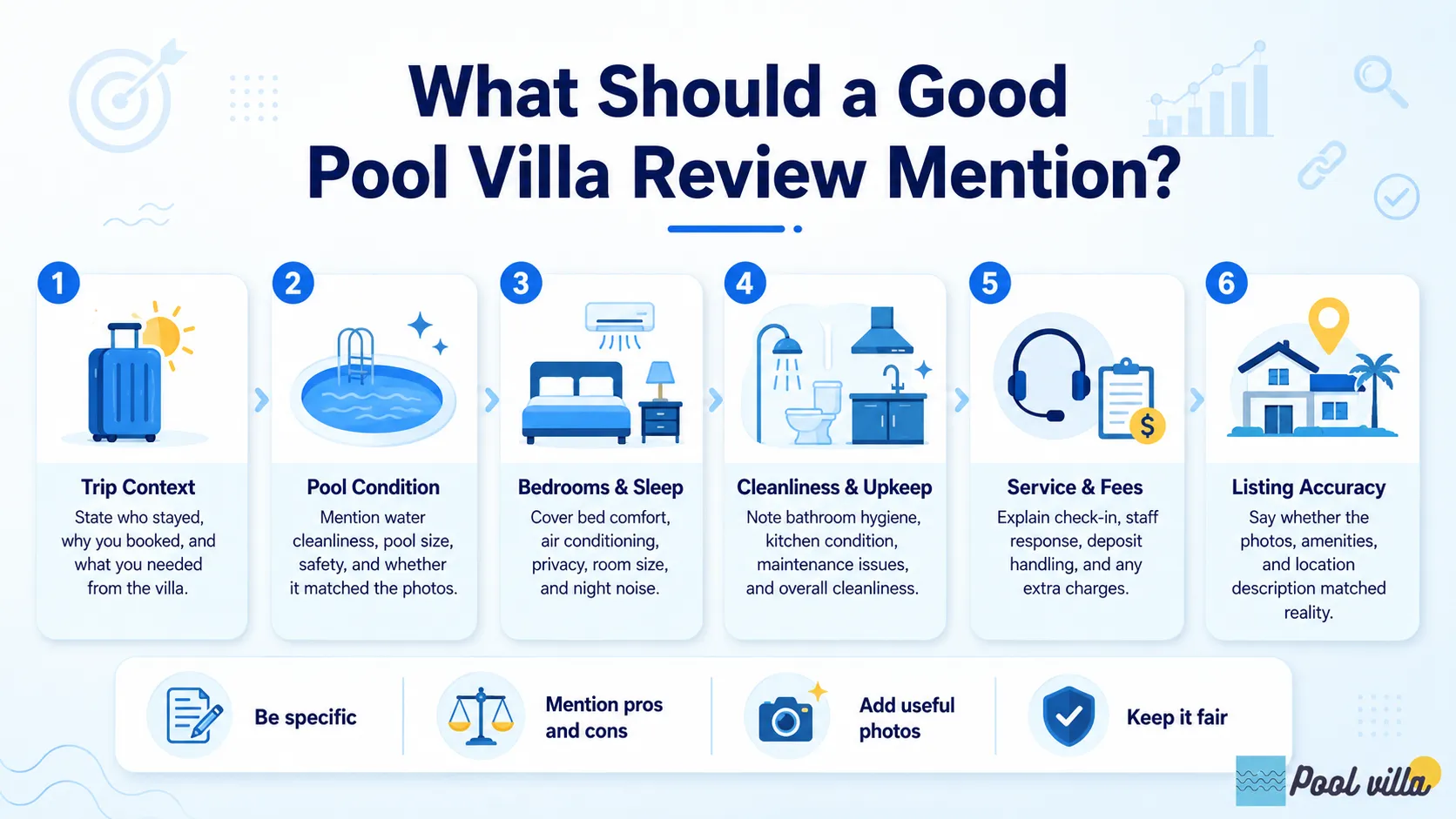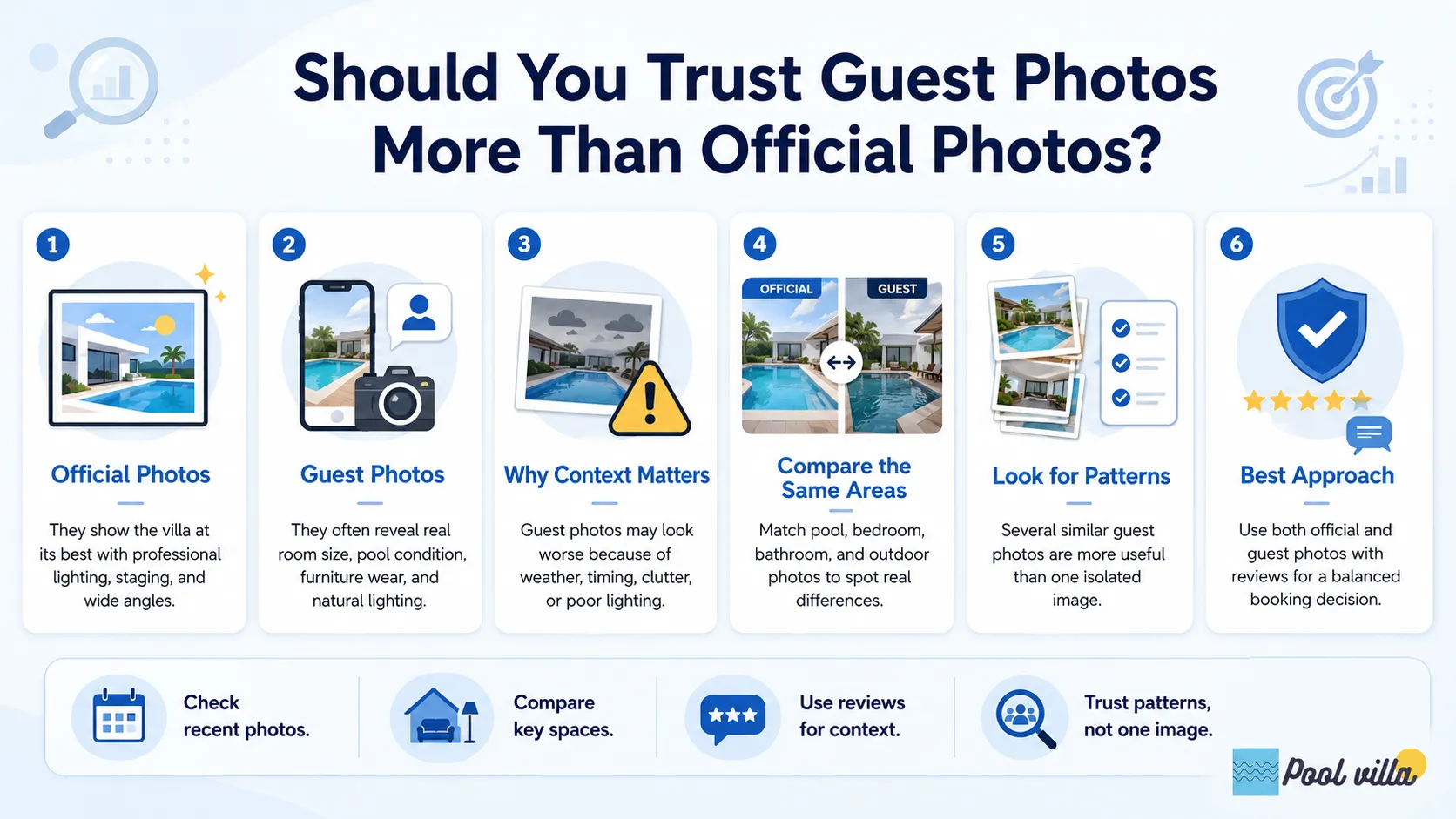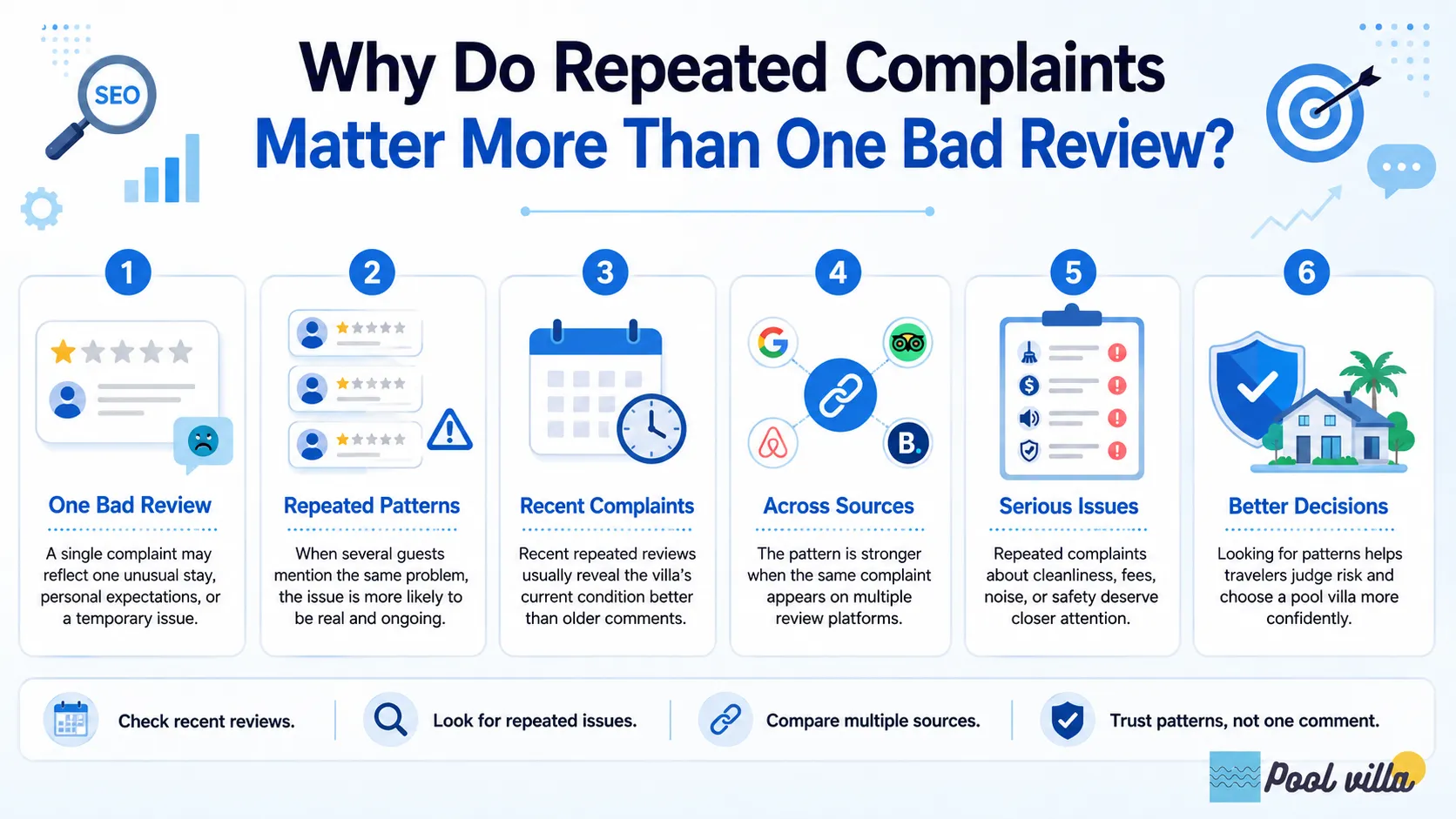

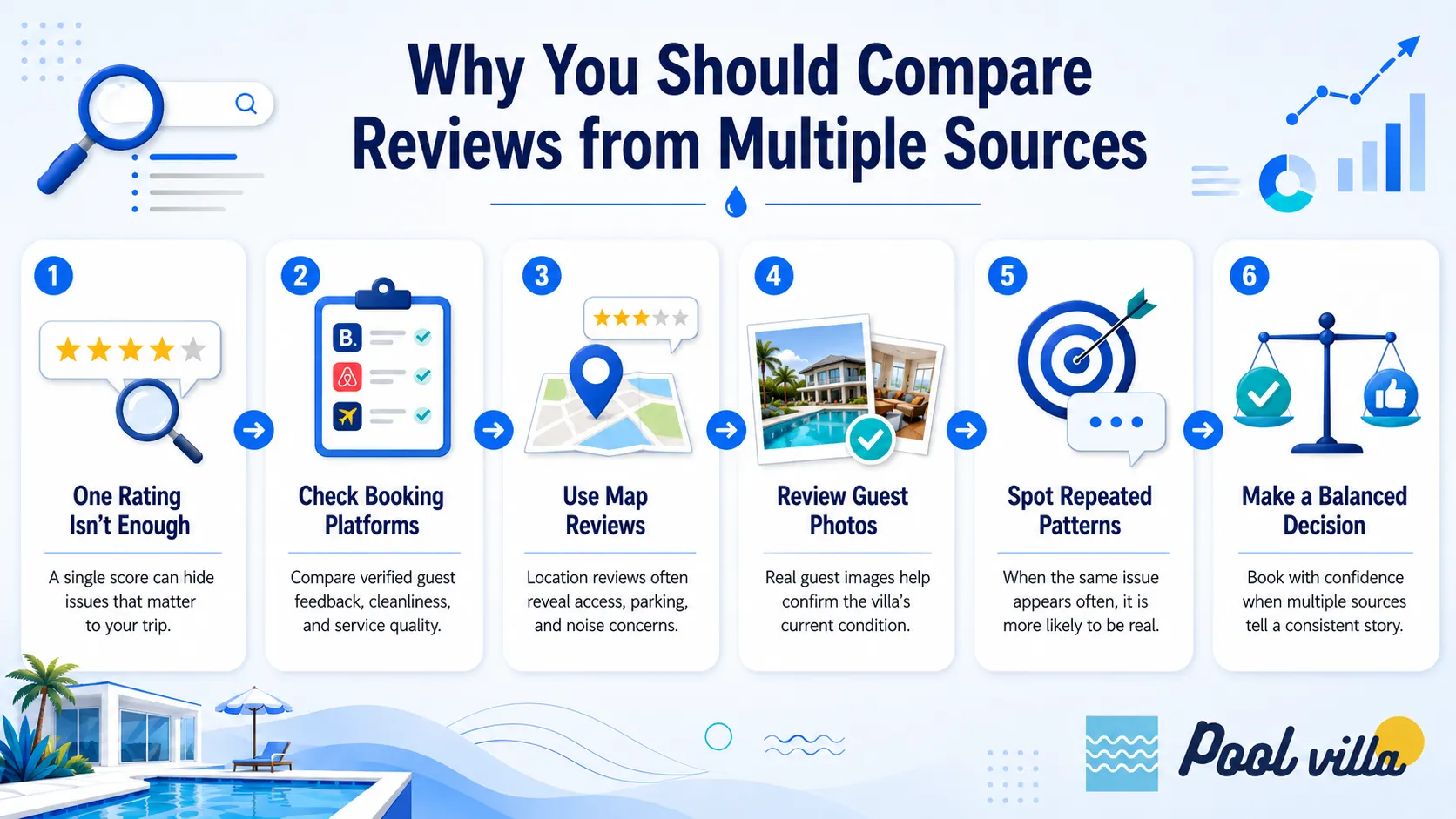
A single review can be useful, but it should rarely decide whether you book a pool villa. One guest may have had an unusually good experience. Another may have been disappointed by something that would not matter to you. What gives reviews real value is the pattern behind them: when they were written, whether the same issues appear repeatedly, and whether the villa seems to be improving, declining, or staying consistent.
Learning how to compare pool villa review dates helps you read feedback more critically. Instead of reacting to one positive or negative comment, you look at the review timeline and ask better questions: Are the complaints recent? Do several guests mention the same problem? Did the host fix the issue? Are older reviews still relevant? Does the current guest experience match the listing?
This guide explains how review dates and repeated patterns reveal more than isolated comments. It helps you evaluate pool villa reviews with a practical, research-focused approach before making a booking decision.
What Does This Topic Mean?
Comparing review dates and patterns means reading pool villa reviews in sequence instead of treating every comment equally.
A review from last month usually tells you more about the villa’s current condition than a review from three years ago. A complaint repeated by several guests is usually more meaningful than one isolated negative comment. A sudden change in review quality may suggest a change in management, maintenance, cleaning standards, pricing, or guest expectations.
In practical terms, you are looking for three things:
- Recency: How recent are the most useful reviews?
- Repetition: Do the same comments appear again and again?
- Direction: Is the villa improving, declining, or staying consistent?
For example, one review saying “the pool was not clean” may be a one-time problem. But if several reviews across recent months mention cloudy water, poor pool maintenance, or strong chemical smell, that becomes a pattern.
The same logic applies to positive reviews. If many recent guests say the host replies quickly, the villa looks like the photos, and the pool is well maintained, those repeated signals build confidence.
Why Does This Matter?
Pool villas often involve higher expectations than ordinary accommodation. Guests usually book them for privacy, group comfort, family time, celebrations, relaxation, or a more personal stay. Because of this, review accuracy matters.
A poor booking choice can affect the entire trip. Problems may include:
- A pool that is not cleaned properly
- Poor air conditioning
- Misleading listing photos
- Bathrooms with odor or drainage issues
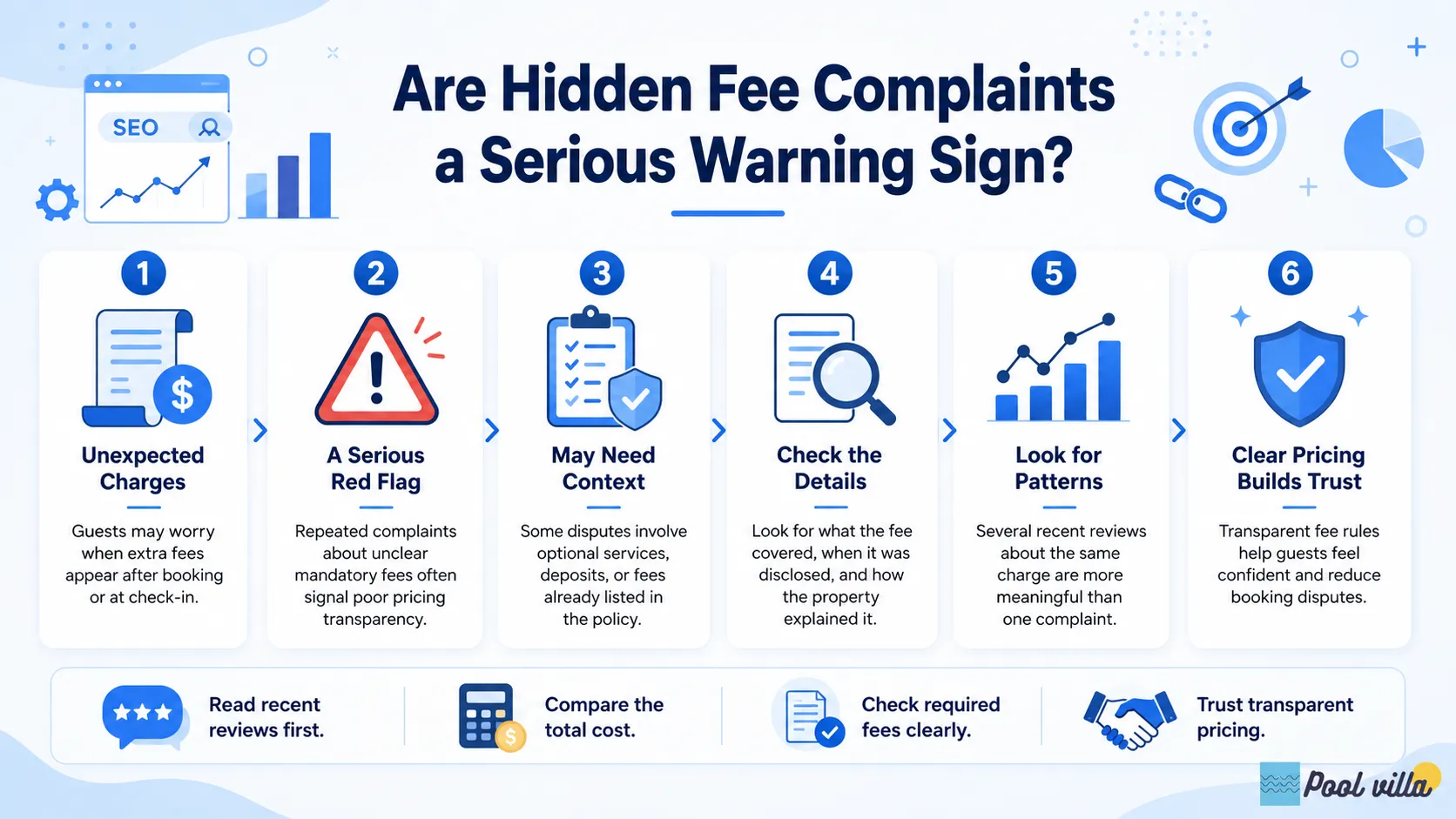
- Unclear extra fees
- Difficult check-in
- Slow host communication
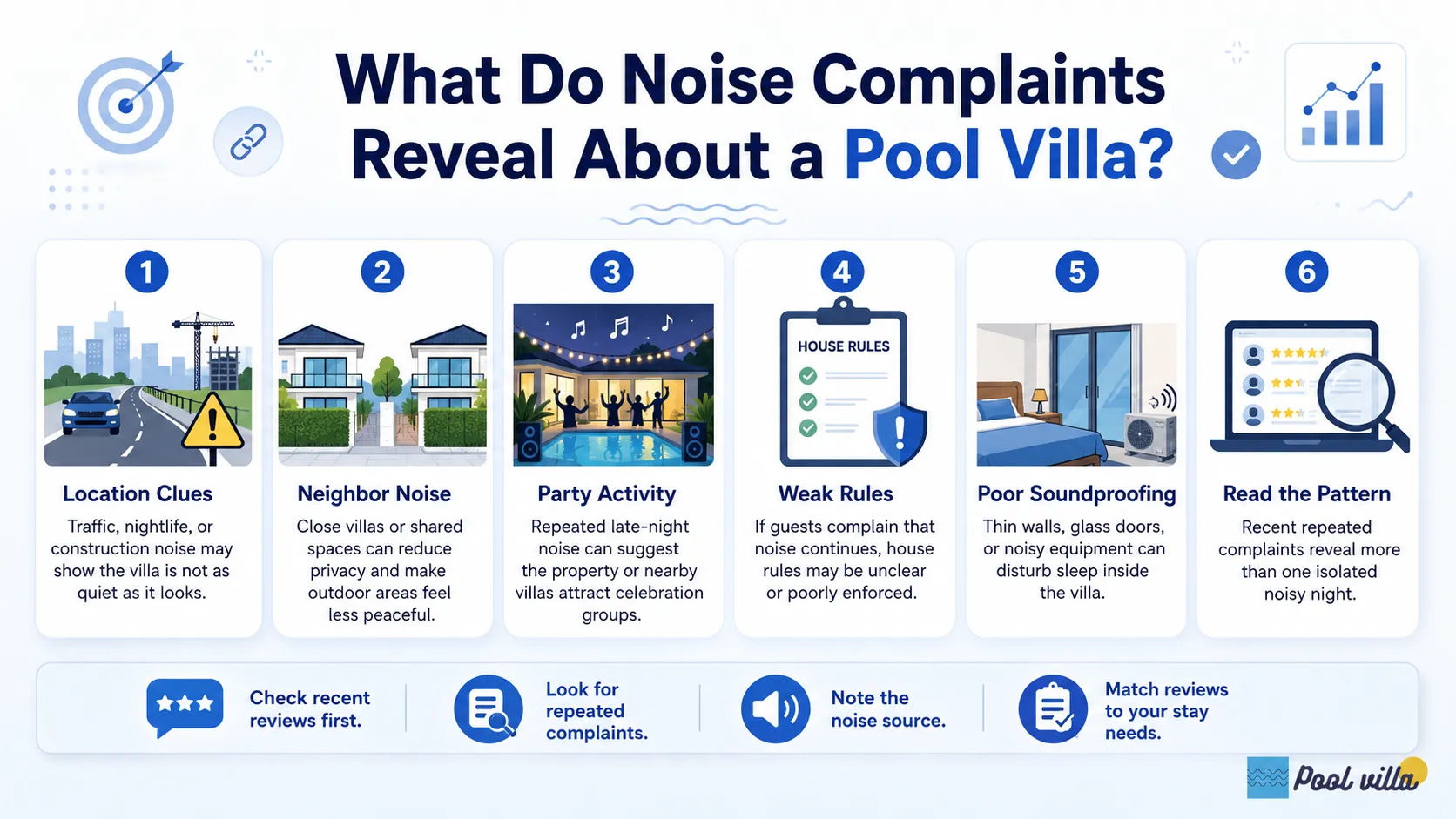
- Noise from nearby properties
- Privacy that does not match the listing
- Maintenance problems that were never fixed
Review dates matter because a pool villa is not static. Its quality can change over time. Furniture wears out. Pools need regular cleaning. Staff may change. Management may improve. A new owner may renovate the property. A popular villa may decline if maintenance does not keep up with heavy use.
This is why the timeline matters. A great review from two years ago does not fully protect you from recent maintenance issues. A bad review from three years ago may not matter if the villa has since improved. When you compare pool villa review dates, you get a clearer picture of the current guest experience.
How Should You Approach It?
The best way to compare reviews is to read them like a timeline. Do not only look at the highest-rated or lowest-rated comments. Look at how guest feedback changes over time.
Start With the Most Recent Reviews
Begin with the latest reviews because they are most likely to reflect the current condition of the villa.
Focus on reviews from the last few months first. If there are many reviews, read enough recent ones to understand the current pattern. If there are only a few reviews, expand your view to the past year.
Recent reviews are especially important for:
- Pool cleanliness
- Air conditioning
- Wi-Fi quality
- Furniture condition
- Bathroom maintenance
- Kitchen equipment
- Host responsiveness
- Noise levels
- Construction nearby
- Road access
- Extra fees
A review from last month mentioning broken pool lights or weak air conditioning may be more important than ten older reviews praising the villa’s design.
Compare Recent Reviews With Older Reviews
After reading recent feedback, compare it with older reviews. This helps you see whether the villa is stable, improving, or declining.
A stable pattern may look like this:
- Older reviews mention clean rooms.
- Recent reviews still mention clean rooms.
- Guests consistently praise the host.
- Complaints remain minor and occasional.
An improving pattern may look like this:
- Older reviews mention slow communication.
- Recent reviews say the host now replies quickly.
- Older complaints about cleanliness stop appearing.
- Guests mention renovation or better maintenance.
A declining pattern may look like this:
- Older reviews are very positive.
- Recent reviews mention worn furniture.
- Guests start complaining about pool cleanliness.
- Several recent reviews mention slow service or poor maintenance.
The direction of the reviews is often more important than the average rating.
Separate One-Time Issues From Repeated Problems
Every villa can have occasional problems. A light may stop working. A guest may arrive during bad weather. A staff member may make a mistake. These things can happen even at well-managed properties.
The key is to identify whether the issue was isolated or repeated.
A one-time issue may appear once and then disappear from later reviews. A repeated problem appears across multiple reviews, especially from different guests.
Examples of repeated problems include:
- Several guests mention insects or mosquitoes indoors.
- Multiple reviews complain about dirty pool water.
- Different guests say the photos look outdated.
- Reviews over several months mention weak air conditioning.
- Guests repeatedly report unclear electricity charges.
- Several people say the host was hard to contact.
Repeated complaints carry more weight because they suggest a management or maintenance pattern, not just one unlucky stay.
Pay Attention to Review Clusters
A review cluster happens when several similar comments appear within a short time. This can reveal a recent change.
For example, if three reviews in the same month mention construction noise nearby, that may be a temporary but important issue. If several guests in peak season complain about slow cleaning or delayed check-in, the property may struggle during busy periods.
Review clusters can also be positive. If several recent guests mention new furniture, improved cleanliness, or helpful staff, the villa may have recently improved.
When you notice a cluster, ask:
- Did the same issue appear in a short period?
- Is it likely to be temporary or ongoing?
- Did later reviews say the issue was fixed?
- Did the host respond with a clear explanation?
- Would the issue affect your trip?
This approach helps you avoid overreacting while still taking useful signals seriously.
What Tools, Materials, or Options Do You Need?
You do not need complicated tools to compare pool villa review dates. Most of the work can be done directly on booking platforms, map listings, or review pages.
Useful options include:
- Review sorting by newest first
- Filters for guest type, such as families or groups
- Guest photo sections
- Keyword search within reviews
- Rating breakdowns by cleanliness, location, service, and value
- Host replies
- Screenshots or notes for comparing villas
The most important “tool” is a structured reading method.
Use Review Sorting
If the platform allows it, sort reviews by newest first. This prevents older or highly rated reviews from shaping your opinion before you see the current situation.
Recommended order:
- Read the newest reviews.
- Check the lowest recent reviews.
- Read mid-range reviews for balanced feedback.
- Compare older reviews to understand long-term patterns.
- Check guest photos if available.
Mid-range reviews are often useful because they tend to include both positives and negatives. A three-star or four-star review may explain the villa more realistically than a very emotional one-star or overly brief five-star review.
Use Keyword Searches
If a platform allows review search, search for words connected to your priorities.
Useful keywords include:
- Pool
- Clean
- Recent
- Noise
- Host
- Staff
- Air conditioning
- Wi-Fi
- Bathroom
- Kitchen
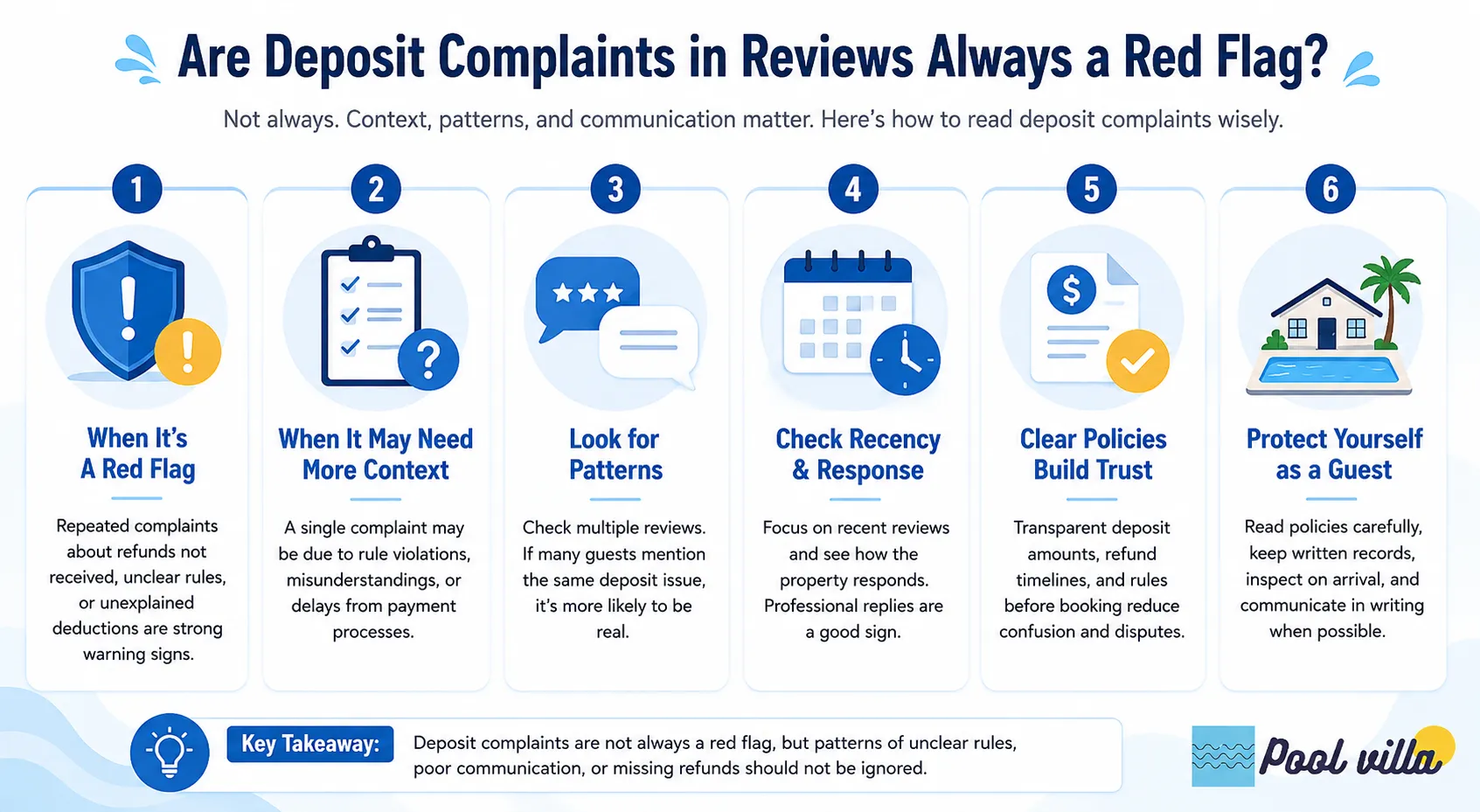
- Deposit
- Electricity
- Location
- Parking
- Privacy
- Kids
- Family
- Maintenance
This helps you find repeated topics quickly. For example, if you search “pool” and find several recent complaints, that is more important than one old comment hidden deep in the review list.
Take Notes When Comparing Several Villas
When choosing between multiple villas, write down the main review patterns for each one.
For example:
- Villa A: strong recent cleanliness reviews, but several guests mention road access.
- Villa B: beautiful photos, but repeated comments about weak air conditioning.
- Villa C: fewer reviews, but host replies quickly and recent guest photos look accurate.
Simple notes help you compare properties based on evidence rather than memory or emotion.
Common Mistakes
Many travelers misread reviews because they focus on the wrong signals. Avoid these common mistakes when comparing review dates and patterns.
Mistake 1: Treating All Reviews Equally
Not every review has the same value. A detailed review from last month is usually more useful than a vague review from several years ago.
Better approach: give more weight to recent, specific, and repeated feedback.
Mistake 2: Ignoring the Timeline
A villa with excellent old reviews may no longer be in the same condition. A villa with old complaints may have improved.
Better approach: check whether the review trend is improving, declining, or consistent.
Mistake 3: Overreacting to One Negative Review
One negative review can feel alarming, especially if it is detailed. But it may not represent the typical guest experience.
Better approach: look for repetition. If the same issue appears again and again, take it seriously.
Mistake 4: Only Reading Five-Star Reviews
Five-star reviews often highlight what guests liked, but they may not mention small problems. Some are also too short to be useful.
Better approach: read a mix of high, medium, and low reviews. Balanced reviews often give the most practical information.
Mistake 5: Ignoring Host Replies
Host replies can reveal whether the property is professionally managed. A clear, respectful response to criticism is a positive sign. Defensive or vague replies may be a concern.
Better approach: check whether the host acknowledges issues, explains improvements, and responds professionally.
Mistake 6: Missing Seasonal Patterns
Some problems appear only during certain periods. Rainy season may affect outdoor areas. Peak season may affect cleaning speed or staff availability. Nearby construction may be temporary.
Better approach: compare reviews from similar travel periods when possible.
Practical Tips for Better Results
Comparing review dates and patterns becomes easier when you know what to look for. The goal is not to find a flawless villa, but to understand the risk level before booking.
Focus on Specific Details
Specific details are more reliable than vague opinions.
Less useful comments:
- “Bad place.”
- “Perfect stay.”
- “Not worth it.”
- “Amazing villa.”
More useful comments:
- “The pool was cleaned every morning.”
- “The air conditioning in the main bedroom was weak.”
- “The photos were accurate, but the road was narrow.”
- “The host replied quickly when we had a problem.”
Specific details help you understand the actual experience.
Compare Positive and Negative Patterns
Do not only look for problems. Repeated positive feedback is also useful.
Strong positive patterns may include:
- Clean pool
- Accurate photos
- Fast host replies
- Quiet surroundings
- Comfortable beds
- Good location
- Clear fees
- Well-equipped kitchen
- Good privacy
Strong negative patterns may include:
- Dirty pool
- Outdated photos
- Poor air conditioning
- Hidden charges
- Slow communication
- Noise complaints
- Maintenance issues
- Insects or mold
- Difficult access
The best decision comes from comparing both sides.
Check Whether Complaints Match Your Priorities
Not every repeated complaint should affect your decision equally. A villa may have repeated comments about being far from nightlife, but that may not matter if you want a quiet stay. Another villa may have repeated comments about noise, which may be serious if you are traveling with children or elderly guests.
Ask yourself:
- Would this issue affect my group?
- Is the complaint about comfort, safety, cost, or preference?
- Is the issue repeated recently?
- Is there evidence it was fixed?
- Does the price still feel fair given the weakness?
This keeps your decision practical rather than emotional.
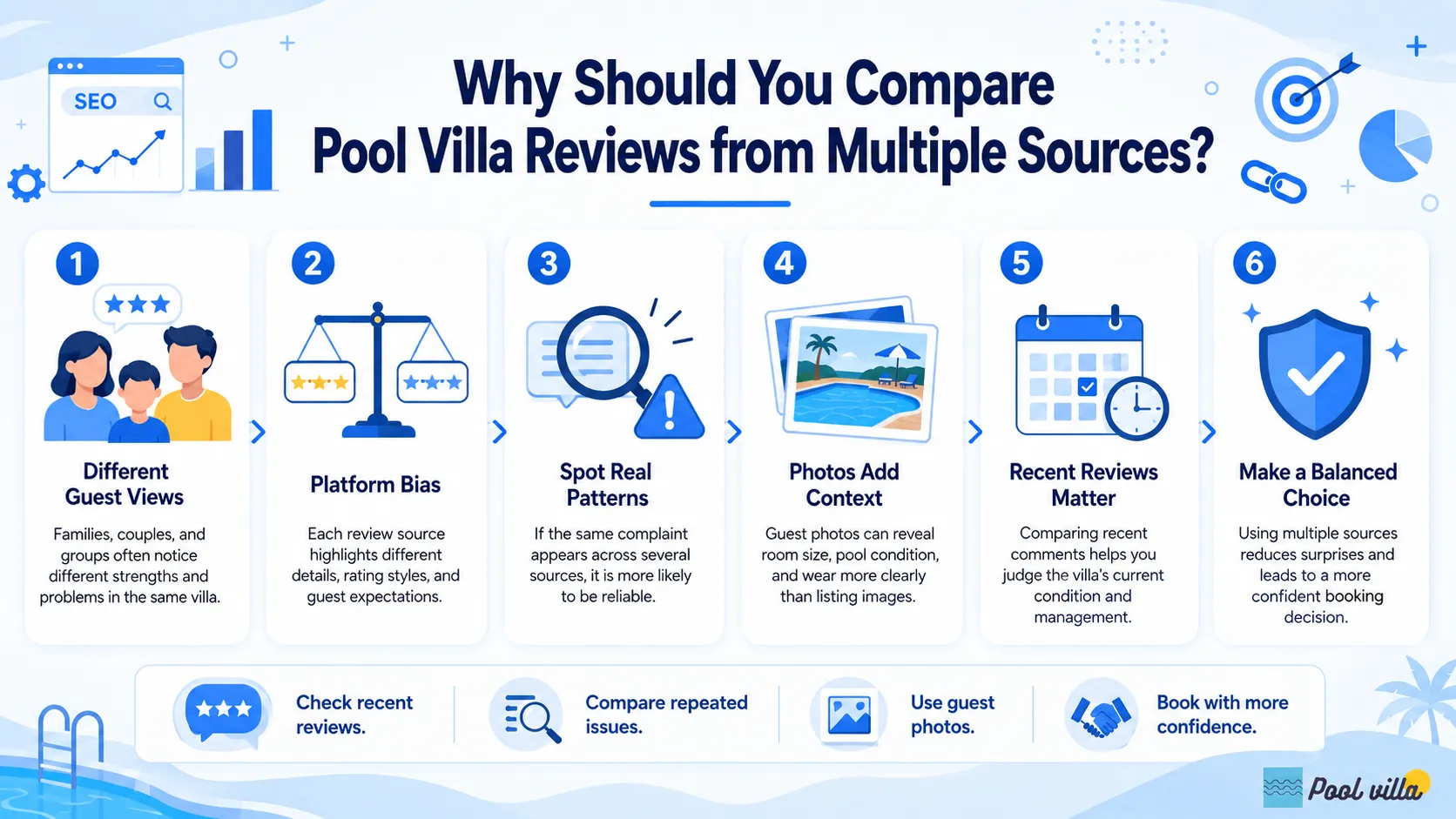
Look for Review Consistency Across Platforms
If possible, compare reviews from more than one source. A property may appear on booking platforms, map listings, social media, or travel websites.
Consistent reviews across platforms build trust. If one platform shows excellent reviews but another has repeated complaints, investigate more carefully.
You do not need every review source to say the same thing, but the overall reputation should make sense.
Watch for Sudden Review Changes
A sudden change in review tone can be important.
Positive change may suggest:
- New management
- Renovation
- Better cleaning standards
- Improved host communication
- Updated facilities
Negative change may suggest:
- Poor maintenance
- Increased guest volume
- Staff changes
- Aging furniture
- New construction nearby
- Less responsive management
When review quality changes suddenly, recent evidence should guide your decision more than old averages.
Maintenance or Prevention
In this topic, maintenance means protecting yourself from avoidable booking problems. You cannot control how a villa is maintained, but you can reduce risk by reading review patterns carefully.
Identify Maintenance Signals Early
Pool villas require ongoing care. Review patterns often reveal whether the property receives enough attention.
Positive maintenance signals include:
- Recent guests praise cleanliness.
- Pool condition is consistently good.
- Problems are fixed quickly.
- Host replies are professional.
- Guest photos match listing photos.
- Reviews mention working air conditioning, hot water, and Wi-Fi.
Negative maintenance signals include:
- Repeated complaints about broken items.
- Several guests mention dirty pool water.
- Photos look older than the listing suggests.
- Reviews describe mold, smell, rust, or stains.
- Host replies are missing or defensive.
- The same issue appears over several months.
If maintenance complaints repeat, do not assume the problem will be fixed before your stay.
Confirm Important Issues Before Booking
If you like a villa but reviews raise concerns, contact the host before booking. Ask direct, specific questions.
For example:
- “Recent reviews mentioned pool cleanliness. How often is the pool cleaned?”
- “Are the photos current?”
- “Is the air conditioning working in every bedroom?”
- “Are there any construction works nearby?”
- “Is electricity included in the price?”
- “Has the issue mentioned in recent reviews been fixed?”
A trustworthy host should answer clearly. If the reply is vague, slow, or avoids the question, treat that as part of your review analysis.
When Should You Be Extra Careful?
Some situations require more caution because the consequences of a bad booking are higher.
When Recent Reviews Are Worse Than Older Reviews
This is one of the clearest warning signs. If a villa was once excellent but recent guests now mention poor cleanliness, weak maintenance, or slow communication, the property may be declining.
Do not let old positive reviews outweigh recent negative patterns.
When the Same Complaint Appears Across Several Months
A repeated issue over several months is unlikely to be a one-time mistake. This may suggest that the host knows about the problem but has not fixed it properly.
This is especially serious for:
- Pool hygiene
- Mold or dampness
- Broken air conditioning
- Plumbing problems
- Electrical issues
- Unsafe pool areas
- Unclear extra charges
When Booking for Families or Large Groups
Families and groups have less flexibility if the villa does not perform well. More guests means more need for working bathrooms, strong air conditioning, enough beds, clean common areas, safe pool access, and clear house rules.
For these bookings, review patterns matter more than isolated praise.
When the Villa Has Very Few Reviews
A new or low-review villa is not automatically bad, but there is less evidence. In this case, review dates cannot reveal much history.
Be more careful with:
- Photo accuracy
- Host communication
- Clear pricing
- Cancellation rules
- Deposit terms
- Guest capacity
- Location details
- Secure payment process
When review history is limited, transparency becomes more important.
FAQ
Why should I compare pool villa review dates?
Review dates help you understand the villa’s current condition. Recent reviews are more likely to reflect today’s cleanliness, maintenance, service quality, and guest experience than older reviews.
Is one negative review enough to avoid a pool villa?
Not always. One negative review may describe a temporary issue or a personal preference. Repeated recent complaints about the same problem are much more important.
How far back should I read pool villa reviews?
Start with the most recent reviews, then look back over several months to one year if available. Older reviews can help identify long-term patterns, but they should not outweigh current feedback.
What does it mean if recent reviews are worse than older reviews?
It may suggest the villa is declining, especially if recent guests mention maintenance, cleanliness, communication, or pool problems. This pattern deserves careful attention before booking.
Are repeated positive comments useful?
Yes. Repeated praise for cleanliness, accurate photos, host communication, pool quality, and privacy can build confidence. Positive patterns are just as important as negative ones.
What should I do if reviews mention a problem I care about?
Contact the host before booking and ask a direct question. If the host gives a clear and professional answer, that is a positive sign. If the answer is vague or defensive, be cautious.
Conclusion
Review dates and patterns reveal far more than one isolated comment. A single review can show one guest’s experience, but repeated feedback over time shows how a pool villa is actually performing.
When you compare pool villa review dates, focus on recency, repetition, and direction. Recent reviews show the current condition. Repeated comments reveal reliable patterns. Changes in review quality help you see whether the villa is improving, declining, or staying consistent.
The goal is not to find a villa with perfect feedback. It is to understand the evidence clearly enough to make a confident decision. A good pool villa should show recent, consistent signs of cleanliness, honest photos, reliable maintenance, clear communication, and fair value.
By reading review timelines carefully, you reduce the risk of surprises and choose a pool villa based on practical evidence rather than one emotional comment or an average star rating.