
Planning accommodation for a group is rarely as simple as counting guests and dividing by two. A comfortable group stay depends on the mix of adults, couples, children, elderly travelers, and individual sleeping preferences. If the bedroom estimate is too low, the trip can quickly become uncomfortable and stressful. If it is too high, the group may pay for unnecessary space.
Understanding how to estimate bedrooms for a group stay helps create a better balance between comfort, privacy, convenience, and budget. This is especially important for vacations, reunions, company retreats, birthday celebrations, and large family trips where different age groups and relationship dynamics are involved.
The right bedroom setup improves sleep quality, reduces conflicts, and makes the overall stay more practical for everyone involved. Instead of relying only on the maximum guest capacity, it is better to evaluate how the group actually plans to sleep and use the property.
What Does Estimating Bedrooms for a Group Stay Mean?
Estimate bedrooms for group stay means determining how many separate sleeping spaces the group realistically needs for comfort and functionality.
This involves more than just bed count. A property may advertise space for 15 or 20 guests, but the actual bedroom arrangement may not suit the group well. Some guests may be comfortable sharing beds, while others may require private rooms or separate sleeping areas.
A proper estimate usually considers:
- Number of couples
- Number of single adults
- Children and teenagers
- Elderly guests
- Bed-sharing preferences
- Privacy expectations
- Sleeping schedules
- Noise sensitivity
For example, a group of 12 adults may technically fit into a four-bedroom property, but that arrangement may not work well if several guests want private sleeping spaces.
The goal is not only to fit everyone into the property but to create a comfortable and realistic sleeping arrangement.
Why Does This Matter?
Bedroom planning has a direct impact on the quality of the stay. Poor sleeping arrangements often create avoidable problems, especially during multi-night trips.
Common issues caused by underestimating bedrooms include:
- Lack of privacy
- Sleep disruption
- Crowded shared rooms
- Bathroom congestion
- Conflicts between guests
- Reduced comfort for older travelers
- Children waking up adults
- Limited storage space
These problems become more noticeable on longer stays or during trips where guests spend a lot of time inside the property.
Proper bedroom estimation also helps with budgeting. A group may initially try to save money by choosing fewer bedrooms, but discomfort can reduce the overall experience. In many cases, paying slightly more for additional bedrooms creates a much better balance between comfort and cost.
For large groups, room allocation should be considered part of the trip planning process rather than a last-minute decision.
How Should You Approach Bedroom Estimation?
The most effective way to estimate bedrooms for a group stay is to break the group into categories instead of looking only at the total number of guests.
Start With Couples
Couples are usually the easiest category to plan for because they typically share one bed and one bedroom.
For example:
- 3 couples usually need 3 bedrooms
- 5 couples usually need 5 bedrooms
However, not all couples are comfortable sharing smaller beds. Some may expect king-size beds or more privacy, especially during longer stays.
If the trip includes newly married couples, elderly couples, or guests traveling for relaxation, comfort expectations may be higher.
Separate Single Adults
Single adults often create the biggest challenge in bedroom planning because sharing expectations vary significantly.
Some groups are comfortable with:
- Twin beds
- Shared rooms
- Sofa beds
- Bunk beds
Other groups prefer:
- Private rooms
- Fewer roommates
- Separate beds
- Quiet sleeping environments
Age also matters. Younger travelers may accept tighter arrangements more easily than older adults.
As a practical guideline:
- 2 single adults per room is usually acceptable
- More than 3 adults in one room often reduces comfort significantly
If the stay lasts several nights, additional bedrooms may become more important.
Consider Children Separately
Children can either simplify or complicate bedroom planning depending on age.
Young children may comfortably stay with parents, especially if:
- Cribs are available
- Extra mattresses can fit in the room
- Parents prefer close supervision
Teenagers often need separate consideration. Older children usually want more privacy and may not want to share with younger siblings.
A family with two adults and three small children may only need one bedroom, while a family with teenagers may require two or three separate sleeping spaces.
Pay Attention to Elderly Guests
Older travelers typically require more comfortable and accessible sleeping arrangements.
Important considerations include:
- Ground-floor bedrooms
- Easy bathroom access
- Quieter sleeping areas
- Fewer stairs
- Proper bed height
- Reduced crowding
Placing elderly guests in living-room sofa beds or bunk beds is usually not practical for multi-night stays.
If grandparents are part of the group, allocating a private bedroom is often the better option.
Account for Bed-Sharing Preferences
Not everyone is comfortable sharing beds, even within the same friend group or extended family.
This is one of the most overlooked parts of estimating bedrooms for a group stay.
Important questions include:
- Are guests comfortable sharing beds?
- Are they comfortable sharing rooms?
- Does anyone snore heavily?
- Are there early sleepers or early risers?
- Are some guests light sleepers?
Ignoring these details often creates unnecessary tension during the trip.
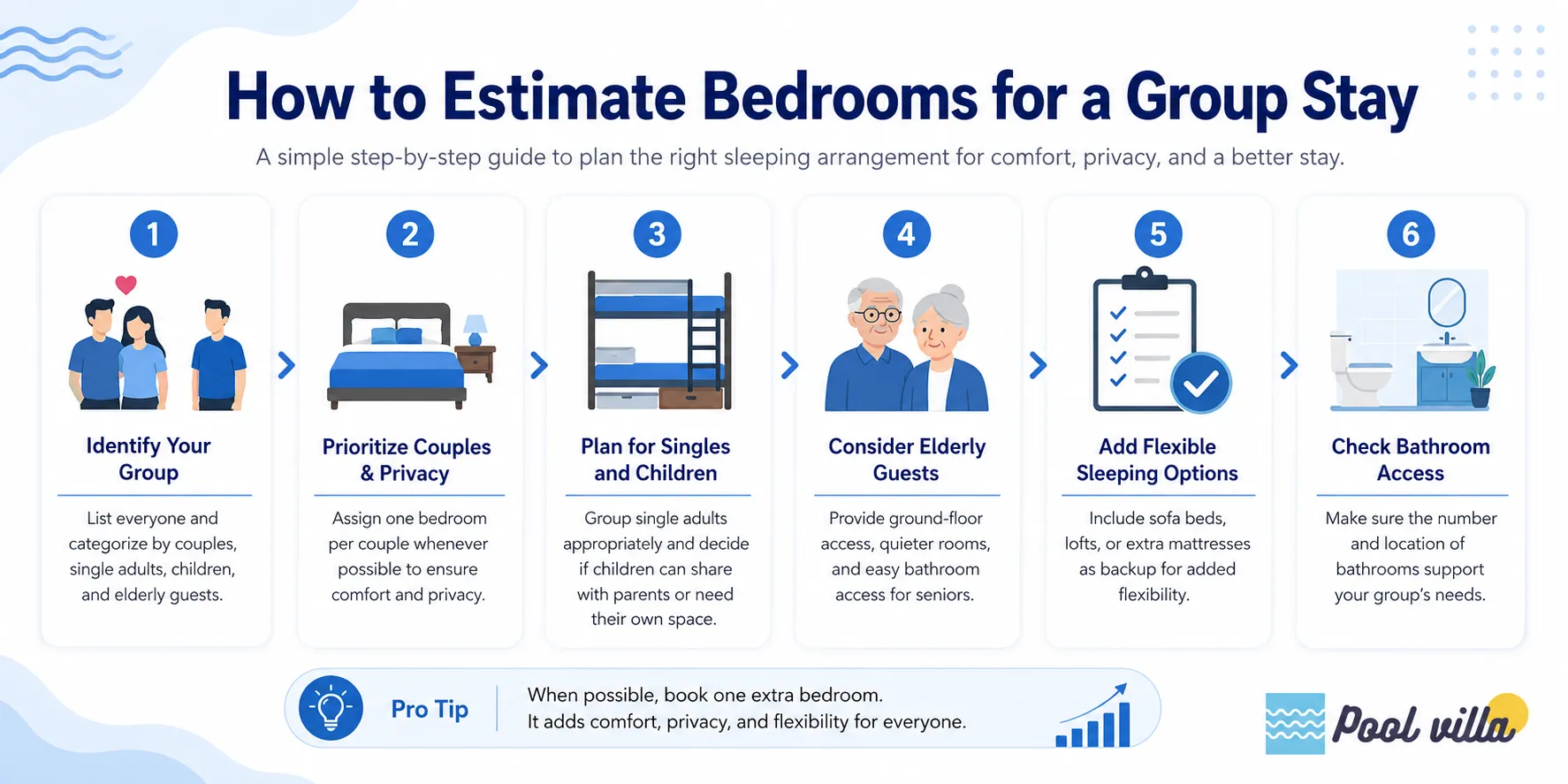
A Practical Bedroom Estimation Method
A simple structured approach can make planning much easier.
Step 1: Count Couples
Assign one bedroom per couple whenever possible.
Example:
- 4 couples = 4 bedrooms
Step 2: Group Single Adults
Estimate how many adults can realistically share rooms comfortably.
Example:
- 4 single adults may need:
- 2 bedrooms with twin beds
- or 1 larger bunk room
The right option depends on the group dynamic.
Step 3: Evaluate Children
Separate children by:
- Age
- Gender if relevant
- Sleep schedule
- Parent preferences
Small children may stay with parents, while teenagers may require separate rooms.
Step 4: Reserve Flexible Sleeping Space
Large group stays benefit from backup sleeping areas such as:
- Sofa beds
- Loft spaces
- Daybeds
- Extra floor mattresses
These spaces help absorb unexpected changes without overcrowding bedrooms.
Step 5: Review Bathroom Access
Bedroom count should match bathroom practicality whenever possible.
For example:
- 14 guests sharing 2 bathrooms may create major morning congestion
- Elderly guests may require nearby bathrooms during the night
Sometimes a property with fewer bedrooms but better bathroom distribution works more effectively.
Common Bedroom Layout Scenarios
Different group types require different planning strategies.
Family Vacation Groups
Family groups often include:
- Parents
- Children
- Grandparents
- Cousins
- Mixed age ranges
These groups usually benefit from:
- Multiple family suites
- Flexible bunk rooms
- Quiet rooms for older adults
Privacy matters less for some families but becomes important during longer stays.
Friend Groups
Friend groups usually prioritize:
- Social spaces
- Fair room distribution
- Shared costs
- Similar comfort levels
However, conflicts may arise if some guests receive significantly better rooms than others.
It is helpful to assign rooms before arrival instead of deciding onsite.
Corporate or Retreat Groups
Work-related trips typically require more privacy.
Many adults are not comfortable sharing beds or crowded rooms with coworkers.
Professional group stays usually work better with:
- Private bedrooms
- Twin-bed setups
- Equal room quality
- Separate quiet spaces
Trying to maximize occupancy too aggressively can reduce the overall experience.
Common Mistakes When Estimating Bedrooms
Focusing Only on Guest Capacity
Maximum occupancy numbers can be misleading.
A property that sleeps 20 guests may rely heavily on:
- Sofa beds
- Floor mattresses
- Bunk beds
- Shared living areas
That setup may technically fit the group but may not be comfortable.
Ignoring Sleep Quality
People often underestimate how important sleep is during group travel.
Poor sleep affects:
- Mood
- Energy levels
- Group dynamics
- Daily activities
Adding one extra bedroom can significantly improve comfort.
Overcrowding Adults
Children may tolerate tighter sleeping arrangements better than adults.
Trying to place too many adults in shared rooms usually reduces privacy and relaxation.
Forgetting Different Sleep Schedules
Some guests wake early while others stay up late.
Mixing incompatible sleeping schedules in crowded rooms often creates frustration.
Assuming Everyone Has the Same Comfort Expectations
Every group contains different personalities and comfort preferences.
Some guests prioritize budget while others value privacy and quiet space.
The best bedroom estimate balances both.
Practical Tips for Better Results
Ask Guests Early
Avoid making assumptions about sleeping arrangements.
Simple early discussions help clarify:
- Bed-sharing comfort
- Roommate preferences
- Accessibility needs
- Privacy expectations
This prevents awkward discussions later.
Prioritize Comfort for Longer Stays
The longer the stay, the more important bedroom comfort becomes.
A crowded setup may work for one night but become difficult during a five-day trip.
Use Flexible Rooms Carefully
Bunk rooms and sofa beds are useful, but they should not become the primary sleeping solution for too many guests.
These setups work best for:
- Children
- Teenagers
- Short stays
- Backup overflow sleeping
Leave Buffer Space if Possible
A slightly larger property often creates a better experience than a fully packed one.
Extra bedrooms provide flexibility for:
- Illness
- Snoring
- Different sleep schedules
- Last-minute guest changes
Consider Noise Distribution
Bedroom location matters almost as much as bedroom count.
Try to separate:
- Late-night social areas
- Young children
- Elderly guests
- Early risers
This improves sleep quality for the entire group.
When Should You Be Extra Careful?
Some situations require more detailed bedroom planning.
Multi-Generational Trips
Groups with grandparents, parents, and children usually need a balanced layout with both privacy and accessibility.
Noise and mobility become important factors.
Large Celebrations
Birthday trips, reunions, and party weekends often involve late-night activity.
Guests who prefer quiet sleep may need rooms farther from entertainment areas.
Properties With Open Sleeping Areas
Some large properties advertise high guest capacity but rely heavily on:
- Open lofts
- Living-room beds
- Convertible furniture
These arrangements may reduce privacy significantly.
Always review the actual bedroom layout carefully.
Groups With Medical or Accessibility Needs
Guests with health concerns may require:
- Ground-floor access
- Nearby bathrooms
- Proper mattresses
- Reduced walking distance
Bedroom estimation should account for these practical needs.
FAQ
How many bedrooms do 10 adults usually need?
It depends on the group type and comfort expectations. Five bedrooms work well for couples, while friend groups may accept shared twin rooms and use fewer bedrooms.
Should children count as full guests when estimating bedrooms?
Yes, but younger children may share rooms with parents more comfortably than teenagers or adults.
Is maximum occupancy the same as comfortable occupancy?
No. Maximum occupancy refers to the absolute sleeping limit, while comfortable occupancy reflects realistic living conditions.
Are bunk beds suitable for adults?
They can work for short stays or casual trips, but many adults prefer standard beds and more privacy during longer stays.
How much extra bedroom space should a group reserve?
If the budget allows, adding one extra bedroom often improves comfort and flexibility significantly.
Conclusion
Learning how to estimate bedrooms for a group stay involves more than calculating headcount. The best sleeping arrangement depends on the mix of couples, single adults, children, elderly guests, and individual comfort expectations.
A realistic bedroom plan improves privacy, sleep quality, convenience, and overall trip satisfaction. It also helps avoid unnecessary tension caused by overcrowded rooms or poor sleeping arrangements.
Instead of relying only on advertised guest capacity, evaluate how the group will actually live and sleep during the stay. Careful planning usually leads to a smoother, more comfortable, and more enjoyable group experience for everyone involved.