
Planning bedrooms for a group stay is rarely as simple as counting people and dividing by two. In pool villas, holiday homes, and large rental properties, the mix of couples, single guests, children, and families has a major effect on how many bedrooms are actually needed.
A villa that comfortably fits 12 guests in theory may feel crowded or impractical if the sleeping arrangement does not match the group structure. Two groups with the same number of guests can require completely different bedroom layouts depending on who is traveling together.
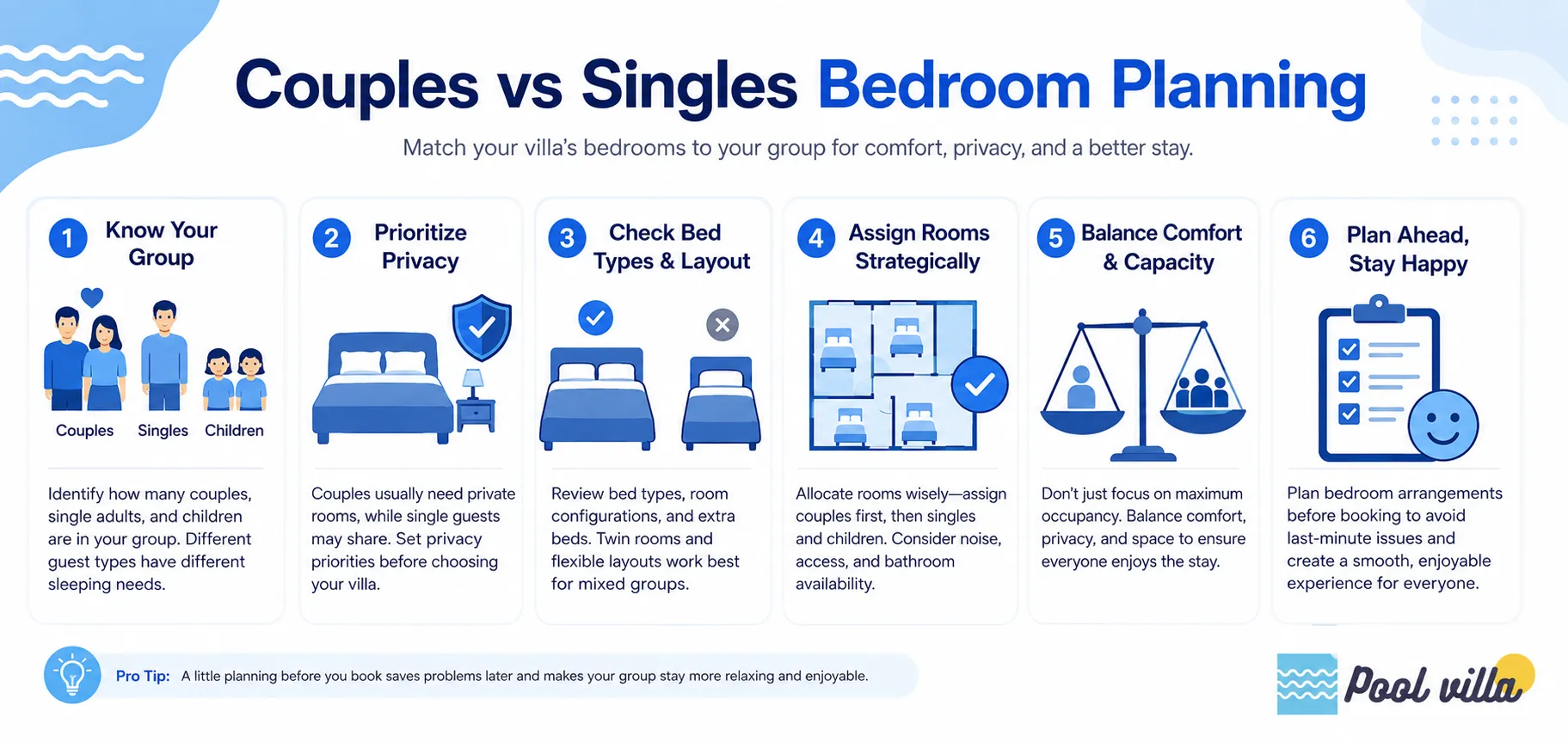
This is why couples vs singles bedroom planning matters. Good bedroom planning improves privacy, sleep quality, convenience, and the overall group experience. Poor planning often leads to awkward room sharing, lack of privacy, noise issues, and disputes during the stay.
This guide explains how couples, singles, children, and mixed groups affect bedroom planning and how to organize sleeping arrangements more realistically.
What Does Couples vs Singles Bedroom Planning Mean?
Couples vs singles bedroom planning refers to organizing bedrooms based on relationship structure and guest categories rather than simply total guest count.
Instead of asking:
- How many people are staying?
You also need to ask:
- How many couples are there?
- How many single guests are there?
- Are children sharing with parents?
- Are guests comfortable sharing rooms?
- Are there elderly guests?
- Does the group prioritize privacy or maximum occupancy?
In practical terms, bedroom planning balances:
- Sleeping capacity
- Privacy
- Comfort
- Space efficiency
- Group dynamics
For example:
- Four couples usually require four bedrooms.
- Eight single adults may require eight separate beds.
- Families with children may prefer larger family rooms instead of multiple small rooms.
- Mixed friend groups may require separate sleeping areas.
This is why bedroom planning is more complex than matching guest count to villa capacity.
Why Does This Matter?
Bedroom planning directly affects comfort and the overall group experience.
Many booking problems happen because guests focus only on maximum occupancy instead of realistic sleeping arrangements.
Privacy Expectations Differ
Couples generally expect private bedrooms. Single guests may be more flexible, but not everyone is comfortable sharing beds or crowded rooms.
A villa advertised for 14 guests may technically fit everyone, but the layout may only work comfortably for:
- 4 couples
- 2 single guests
If the group instead contains:
- 2 couples
- 10 single adults
the same villa may feel overcrowded.
Bed Count Is Different From Bedroom Count
Many villas increase occupancy using:
- Sofa beds
- Extra mattresses
- Bunk beds
- Floor mattresses
This increases guest capacity without improving privacy.
The important question is not only:
- How many guests can stay?
but also:
- How many comfortable sleeping spaces are available?
Children Change Bedroom Requirements
Children often reduce the number of bedrooms needed because younger kids may sleep with parents or siblings.
Examples include:
- Toddlers sleeping with parents
- Siblings sharing twin beds
- Teenagers sharing family rooms
However, older children and teenagers usually require more personal space during longer stays.
Poor Planning Creates Group Tension
Bad room planning often causes:
- Unequal privacy
- Noise issues
- Awkward room sharing
- Complaints about room quality
- Arguments during check-in
Planning ahead helps avoid these problems.
How Should You Approach It?
Effective couples vs singles bedroom planning starts with understanding the group structure first and the villa layout second.
Step 1: Separate Guests Into Categories
Divide guests into practical sleeping groups:
- Couples
- Single adults
- Children
- Teenagers
- Elderly guests
For example:
- 3 couples = 3 bedrooms minimum
- 4 single adults = 2 twin-share rooms
- 2 children = shared family room possible
This creates a more realistic bedroom estimate.
Step 2: Decide the Privacy Level
Different groups have different comfort levels.
A close friend group may accept shared rooms easily, while corporate groups or extended families often require more privacy.
Ask practical questions such as:
- Are guests comfortable sharing rooms?
- Are shared beds acceptable?
- Does anyone need quiet sleeping space?
- Are mixed-gender shared rooms acceptable?
Step 3: Review Actual Bed Types
Always check:
- King beds
- Queen beds
- Twin beds
- Bunk beds
- Sofa beds
- Extra mattresses
A six-bedroom villa may still be unsuitable if all rooms contain only double beds while the group includes many single travelers.
Step 4: Assign Couples First
Couples usually have the least flexibility. Assign private rooms to couples first before organizing single guests.
Example:
- 5 bedrooms
- 3 couples
- 4 singles
Possible arrangement:
- 3 private bedrooms for couples
- 2 twin-share rooms for singles
Step 5: Consider Bathroom Access
Bathroom layout matters almost as much as bedroom count.
Large groups become less comfortable when too many guests share bathrooms.
This is especially important for:
- Corporate groups
- Multi-family stays
- Elderly guests
- Large mixed groups
Bedroom Planning for Different Group Types
Different travel groups require different planning strategies.
Couples-Heavy Groups
Groups dominated by couples usually need:
- More bedrooms
- Better privacy
- Ensuite bathrooms
- Quiet sleeping areas
For these groups, bedroom count matters more than total bed count.
Singles-Heavy Groups
Groups with many single adults require:
- More separate beds
- Twin-bed layouts
- Flexible room sharing
- Fair room distribution
Dorm-style sleeping arrangements may work for budget trips but reduce comfort during longer stays.
Families With Children
Families usually prioritize convenience and supervision over maximum privacy.
Useful layouts include:
- Family suites
- Triple rooms
- Bunk-bed rooms
- Connected bedrooms
Younger children usually reduce bedroom demand, while teenagers increase it.
Mixed Groups
Mixed groups are the most difficult to organize.
Examples include:
- Multiple families traveling together
- Friends plus couples
- Corporate groups with partners
- Multi-generational stays
These groups require careful balance between:
- Privacy
- Comfort
- Fairness
- Sleeping capacity
What Options Work Best for Flexible Bedroom Planning?
Some villa layouts are more adaptable for mixed guest structures.
Twin-Convertible Bedrooms
Rooms that allow:
- Twin beds
- King bed conversion
offer much greater flexibility for mixed groups.
Family Rooms
Large family rooms reduce the need for extra bedrooms while keeping parents and children together.
These rooms often include:
- Extra single beds
- Sofa beds
- Bunk beds
Separate Guest Houses
Large villas with detached guest rooms improve privacy for:
- Couples
- Families
- Elderly guests
They also reduce noise issues between groups.
Bunk Rooms
Bunk rooms work well for:
- Children
- Teenagers
- Budget group travel
However, many adults may find them uncomfortable for extended stays.
Extra Beds and Floor Mattresses
Extra beds help increase occupancy but should not replace proper bedroom planning.
They are best suited for:
- Children
- Short stays
- Backup sleeping arrangements
Common Mistakes
Choosing a Villa Based Only on Maximum Capacity
A villa advertised for 20 guests may only comfortably suit:
- 6 couples
- 2 children
The same villa may feel crowded for 20 single adults.
Ignoring Bed Types
Problems happen when:
- Single guests must share double beds
- Adults receive bunk beds
- Couples receive split twin beds unexpectedly
Always confirm bed arrangements before booking.
Underestimating Privacy Needs
Groups often assume everyone will be flexible, but privacy expectations vary significantly.
Longer stays usually increase the importance of personal space.
Unequal Room Allocation
Some bedrooms are clearly better than others.
Differences may include:
- Ensuite bathrooms
- Better views
- Larger room sizes
- Better noise isolation
Without planning, this can create tension within the group.
Overusing Extra Beds
Too many extra mattresses reduce:
- Walking space
- Sleep quality
- Overall comfort
This often makes large villas feel overcrowded.
Practical Tips for Better Results
Plan Rooms Before Booking
Do not wait until arrival to organize bedrooms.
Create a rough room allocation plan before confirming the property.
Ask for a Floor Plan
Photos may not clearly show:
- Bed sizes
- Room layouts
- Bathroom access
- Noise separation
A floor plan helps prevent surprises.
Prioritize Couples and Elderly Guests
These guests usually benefit most from:
- Private rooms
- Quiet areas
- Easier bathroom access
Assign these rooms first whenever possible.
Leave Flexibility for Changes
Guest numbers often change before travel dates.
Flexible room layouts help accommodate:
- Last-minute cancellations
- Additional guests
- Changing family arrangements
Consider the Length of Stay
One-night stays allow tighter sleeping arrangements.
Longer stays require:
- Better comfort
- More privacy
- Additional storage space
- Better bathroom access
When Should You Be Extra Careful?
Some situations require more detailed planning.
Corporate or Professional Groups
Colleagues usually require more privacy than friends or family groups.
Shared beds are generally inappropriate for professional stays.
Multi-Generational Family Trips
Older guests may require:
- Ground-floor rooms
- Easier bathroom access
- Quieter sleeping areas
Long-Stay Bookings
Privacy becomes more important during longer stays.
Overcrowded sleeping arrangements may create frustration after several nights.
Mixed-Gender Friend Groups
These groups often require more thoughtful room planning, especially when guests do not know each other well.
Twin rooms usually work better than shared double beds.
FAQ
How many bedrooms do couples usually need?
Most couples expect one private bedroom per couple for comfort and privacy.
Are sofa beds suitable for adults?
Sofa beds may work for short stays, but they are generally less comfortable than standard beds for multiple nights.
Should children count as full guests when planning bedrooms?
Yes, but younger children often reduce the need for additional bedrooms because they may share rooms with parents or siblings.
Is bedroom count more important than guest capacity?
For comfort and privacy, bedroom count is often more important than maximum occupancy numbers.
What is the best layout for mixed groups?
Flexible layouts usually work best, including:
- Twin-convertible rooms
- Family suites
- Multiple bathrooms
- Separate sleeping zones
Conclusion
Couples vs singles bedroom planning is about more than fitting guests into available space. It is about creating comfortable and realistic sleeping arrangements that match the structure of the group.
The number of couples, single travelers, children, and families can completely change how suitable a villa feels, even when guest capacity remains the same.
Good bedroom planning improves privacy, reduces tension, and creates a more enjoyable group stay. Poor planning often leads to overcrowding, awkward room sharing, and unnecessary stress.
The best approach is to evaluate the group structure carefully, review the actual bedroom layout, and prioritize comfort over maximum occupancy whenever possible.