
Family pool villa bedroom count is one of the most important details to check before booking. A villa may look spacious in photos, but the number of bedrooms, bed types, bathroom access, and room locations can strongly affect how comfortable the stay feels for parents, children, grandparents, and mixed-age groups.
A family pool villa stay usually needs more planning than a simple hotel stay. Families may need rooms close together, separate sleeping spaces for children, quiet rooms for grandparents, enough bathrooms, and space for naps or early bedtimes. The right bedroom count is not only about how many people can fit inside the villa. It is about whether everyone can sleep comfortably and whether the layout supports the family’s daily routine.
This guide explains how to think about family pool villa bedroom count, including parents, children, grandparents, babies, teenagers, mixed families, and multi-generation trips.
What Does Family Pool Villa Bedroom Count Mean?
Family pool villa bedroom count means the number of bedrooms a family needs for a comfortable pool villa stay. It includes more than the total number of rooms. Families should also check bed sizes, room locations, bathroom access, privacy, noise, and whether bedrooms are suitable for different age groups.
A villa may say it sleeps eight guests, but that does not always mean it has four comfortable bedrooms. The capacity may include sofa beds, extra mattresses, bunk beds, or shared double beds. These setups can work for some families, but they should be clear before booking.
When checking family pool villa bedrooms, consider:
- number of adults
- number of children
- children’s ages
- grandparents or older relatives
- babies or toddlers
- couples within the family
- bed types
- bathroom access
- room distance from parents
- stairs or separate buildings
- quiet rooms for early sleepers
- privacy needs
The best bedroom count depends on the family structure and how people actually sleep.
Why Bedroom Count Matters for Families
Bedroom count matters because poor sleeping arrangements can affect the whole trip. If children cannot sleep well, parents may not rest. If grandparents are placed in a room far from the bathroom, the stay may feel inconvenient. If teenagers have no privacy, they may feel uncomfortable. If toddlers sleep too far from parents, supervision may become stressful.
A good pool villa bedroom count for families helps with:
- better sleep
- easier supervision
- privacy for adults
- quiet spaces for children
- comfort for grandparents
- smoother bedtime routines
- better bathroom access
- less conflict between family members
- more relaxed mornings and evenings
Bedrooms are not only for sleeping. They also become private spaces for changing clothes, resting, storing luggage, calming children, taking calls, or having quiet time away from the group.
Start with the Real Family Group
Before deciding bedroom count, list who is actually staying. Do not begin with the villa’s maximum capacity. Begin with the family’s real needs.
Ask:
- How many adults are staying?
- How many children are staying?
- What are the children’s ages?
- Are grandparents joining?
- Are there multiple couples?
- Does anyone need a private room?
- Does anyone need to sleep near a bathroom?
- Does anyone wake early or sleep late?
- Does anyone need quiet space for naps?
- Are there babies or toddlers who need supervision?
A family with two parents and two young children may need a different setup from a family with parents, teenagers, grandparents, and cousins.
Bedroom Count for Parents and Young Children
For parents with babies, toddlers, or young children, closeness matters. Parents may want children in the same room, an adjoining room, or a nearby bedroom.
A family with very young children may be comfortable with:
- one large bedroom for parents and a baby cot
- two bedrooms, one for parents and one for children
- connecting or nearby rooms
- bedrooms on the same floor
- rooms away from pool access
For young children, safety may matter more than privacy. A room far from parents, near stairs, or with direct pool access may be less suitable.
When checking family pool villa bedroom count, ask whether children can sleep close enough to parents for comfort and supervision.
Bedroom Count for Older Children
Older children may need more space than younger children. They may not want to share a bed, and they may prefer a room with separate beds.
For older children, check:
- twin beds
- bunk beds
- extra mattresses
- room size
- bathroom access
- noise from shared areas
- storage for bags
- air conditioning
- privacy from adults
A bedroom with one double bed may not work well for two older children unless they are comfortable sharing. Families should check bed types, not just room numbers.
If children have different sleep schedules, separate rooms may be helpful. For example, a younger child may sleep earlier, while an older child may stay up longer.
Bedroom Count for Teenagers
Teenagers often need more privacy than younger children. They may be comfortable sharing with siblings or cousins, but they may not want to share with younger children or adults.
For teenagers, consider:
- separate beds
- privacy for changing
- Wi-Fi access
- bathroom access
- distance from parents
- quiet space
- room sharing preferences
- gender comfort in mixed family groups
A villa with fewer bedrooms may still work if the rooms have twin beds or enough space. However, if teenagers are expected to sleep on sofas or floor mattresses, this should be agreed before booking.
A comfortable family pool villa bedroom count should respect privacy as children get older.
Bedroom Count for Grandparents
Grandparents may need extra comfort, privacy, and convenient bathroom access. A room that works for younger adults may not be suitable for older relatives if it requires stairs, has a low bed, or is far from a bathroom.
For grandparents, check:
- ground-floor bedroom, if possible
- nearby bathroom
- easy walking path
- good lighting
- quiet room location
- comfortable bed
- air conditioning
- minimal stairs
- safe bathroom floor
- room away from late-night activity
If grandparents are joining, bedroom count should not only focus on fitting everyone. It should also consider ease of movement and rest.
A villa with one extra bedroom for grandparents can make a multi-generation stay much more comfortable.
Bedroom Count for Multi-Generation Families
Multi-generation families often need more bedrooms because there are different privacy levels and routines. Parents, children, grandparents, aunts, uncles, and cousins may all have different sleeping needs.
A multi-generation family may need:
- one room for grandparents
- one room for parents
- one or more rooms for children
- separate rooms for other adult couples
- quiet rooms away from activity areas
- enough bathrooms for morning routines
For this type of trip, family pool villa bedroom count should be based on household units. Each adult couple may need a private room. Children may share by age group. Grandparents may need the most accessible room.
The more mixed the family group, the more important privacy becomes.

Bed Types Matter More Than Room Count Alone
Bedroom count can be misleading if bed types are not checked. A three-bedroom villa may work better than a four-bedroom villa if it has better bed arrangements and bathrooms.
Check:
- king beds
- queen beds
- twin beds
- bunk beds
- sofa beds
- extra mattresses
- baby cots
- whether bedding is included
- whether extra beds cost more
For families, twin beds are often useful because siblings or cousins may not want to share a double bed. Bunk beds can work for older children but may not be suitable for toddlers. Extra mattresses can be acceptable for short stays but may be uncomfortable for longer trips.
Always ask for the actual sleeping setup, not only the guest capacity.
Bathroom Access and Bedroom Planning
Bedrooms and bathrooms should be planned together. A villa may have enough bedrooms but too few bathrooms for the family size.
Check:
- total number of bathrooms
- ensuite bathrooms
- shared bathrooms
- bathroom distance from bedrooms
- bathroom access for children
- bathroom access for grandparents
- bathroom near the pool
- shower safety
- hot water
- towel supply
For families, bathroom access can affect mornings, pool time, bedtime, and checkout. If everyone needs to shower after swimming or before going out, too few bathrooms can become frustrating.
A good pool villa bedroom count for families should include enough bathroom access to support the group’s routine.
Room Location and Safety
Room location is just as important as bedroom count. Some villas have bedrooms in separate buildings, on different floors, or directly beside the pool.
For families with children, check:
- are bedrooms on the same floor?
- are children’s rooms close to parents?
- do bedrooms open directly to the pool?
- are there stairs between rooms?
- are there balcony doors?
- are rooms close to outdoor areas?
- can doors lock securely?
- can children leave the room unnoticed?
A villa with enough bedrooms may still be difficult if the rooms are too spread out. Families with young children usually benefit from rooms close together.
For families with teenagers, a little separation may be fine. For toddlers, separation can be stressful.
Quiet Rooms and Sleep Schedules
Different family members may have different sleep routines. Babies may nap during the day. Young children may sleep early. Teenagers may stay up later. Grandparents may wake early.
When checking family pool villa bedrooms, consider noise sources:
- living room
- pool area
- dining area
- kitchen
- outdoor terrace
- karaoke or entertainment space
- road noise
- neighboring villas
- pool equipment
A bedroom near the pool or living room may be convenient but noisy. Early sleepers may need rooms farther from shared areas.
Quiet room planning can make the whole stay smoother.
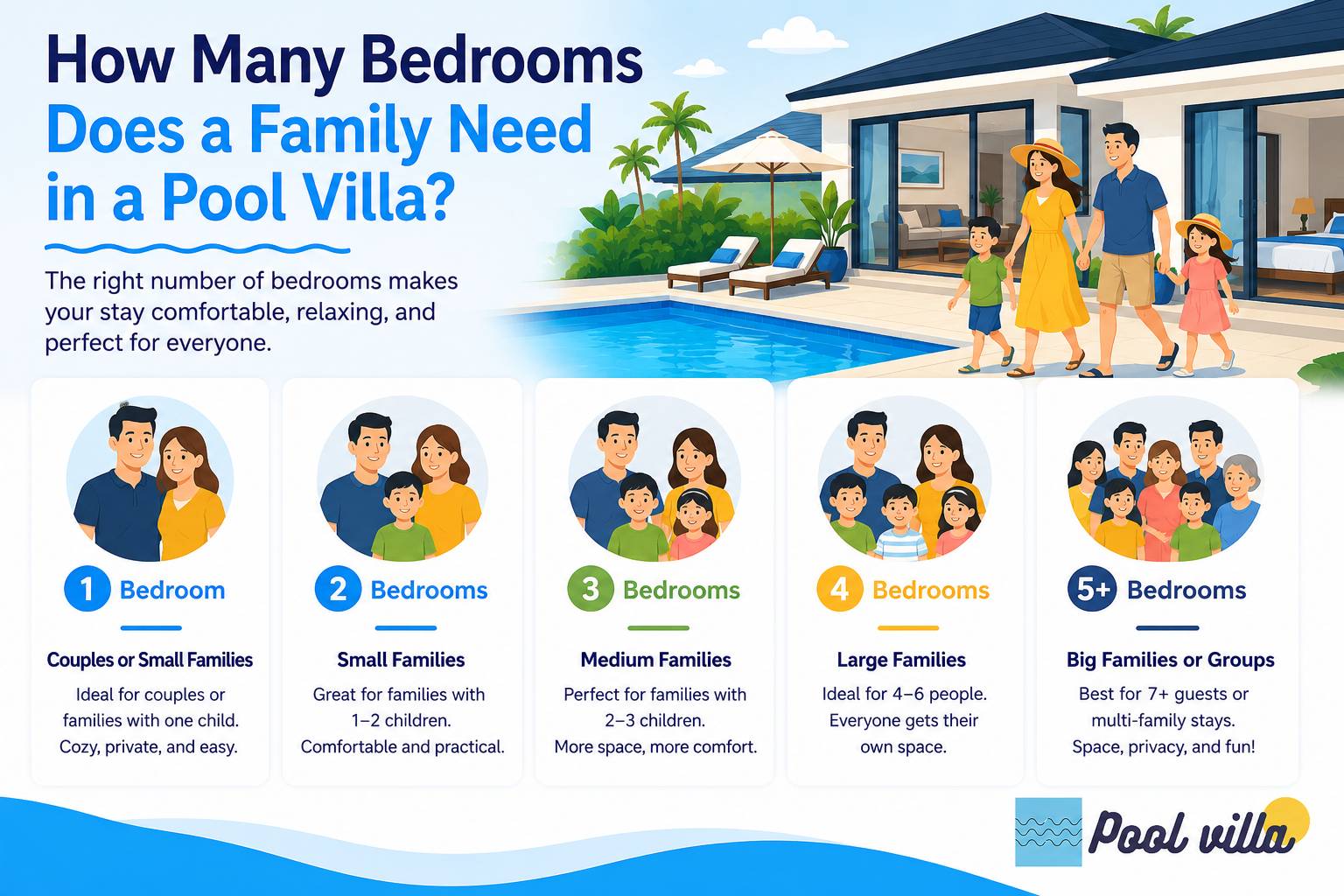
How Many Bedrooms Does a Small Family Need?
A small family with two adults and one or two young children may need one or two bedrooms, depending on the children’s ages and sleep habits.
One bedroom may work when:
- the child is a baby
- a cot is available
- the stay is short
- parents are comfortable sharing the room
- the room is large enough
Two bedrooms may be better when:
- children are older
- parents need privacy
- children have earlier bedtime
- naps are important
- the stay is longer
For many small families, two bedrooms provide a better balance of comfort and flexibility.
How Many Bedrooms Does a Family of Four Need?
A family of four often needs two bedrooms. This usually allows one room for parents and one room for children.
However, the bed setup matters. If the children are older, twin beds may be better than one double bed. If the children are very young, parents may prefer the children’s room nearby or connected.
A family of four may need three bedrooms if:
- children are teenagers
- children are different genders and prefer separate rooms
- one child needs quiet space
- grandparents or another adult joins
- the stay is long
- one parent needs a workspace or private room
The right count depends on privacy, comfort, and stay length.
How Many Bedrooms Does a Large Family Need?
A large family may need three, four, or more bedrooms depending on the number of adults and children.
A useful method is to count adult couples first. Each adult couple usually needs one bedroom. Then group children by age and comfort level.
For example:
- parents: one bedroom
- grandparents: one bedroom
- two young children: one shared bedroom
- two teenagers: one or two bedrooms depending on comfort
This type of planning is more realistic than relying on total guest capacity.
For large families, extra bathrooms are just as important as extra bedrooms.
Short Stay vs. Long Stay Bedroom Needs
The length of stay affects bedroom count. A setup that works for one night may not feel comfortable for a week.
For short stays, families may accept:
- children sharing beds
- extra mattresses
- less privacy
- fewer bathrooms
- smaller rooms
For longer stays, families should prioritize:
- proper beds
- more privacy
- storage space
- better bathroom access
- quieter rooms
- more comfortable sleeping arrangements
If the family will spend many days in the villa, bedroom comfort becomes more important.


Common Mistakes to Avoid
Mistake 1: Trusting Maximum Guest Capacity
Maximum capacity may include sofa beds or extra mattresses.
Better approach: Ask for the real bedroom and bed setup.
Mistake 2: Ignoring Children’s Ages
A setup that works for toddlers may not work for teenagers.
Better approach: Plan based on age, privacy, and sleep habits.
Mistake 3: Forgetting Grandparents
Older relatives may need accessible rooms and nearby bathrooms.
Better approach: Assign comfortable rooms based on mobility and rest needs.
Mistake 4: Choosing Too Few Bedrooms
Fewer rooms may save money but reduce comfort.
Better approach: Consider the full routine, not only sleeping space.
Mistake 5: Not Checking Bathroom Access
Bedrooms without nearby bathrooms can be inconvenient.
Better approach: Plan rooms and bathrooms together.
Mistake 6: Leaving Room Decisions Until Arrival
Room allocation can become awkward at check-in.
Better approach: agree on sleeping arrangements before the trip.
Practical Tips for Choosing the Right Bedroom Count
Start with the family structure. Count parents, children, grandparents, couples, and single adults separately.
Check actual beds. Do not rely only on room count or guest capacity.
Prioritize young children’s supervision. Children should sleep close enough to parents when needed.
Give grandparents convenient rooms. Avoid stairs and far bathrooms where possible.
Plan for privacy. Older children, teenagers, and adult relatives may need more separation.
Match bedrooms to bathrooms. Enough bathrooms can make the stay much easier.
Think about noise. Early sleepers should not be beside the main social area.
Choose more space for longer stays. Comfort matters more when the stay lasts several nights.
When Should Families Book More Bedrooms?
Families should consider booking more bedrooms when:
- children are older
- teenagers need privacy
- grandparents are joining
- multiple couples are staying
- the stay is longer than a few nights
- children have different sleep schedules
- someone needs a quiet room
- extra mattresses would be uncomfortable
- bathrooms are limited
- rooms are far apart or awkwardly arranged
More bedrooms may cost more, but they can reduce stress and improve sleep for everyone.
Cost, Time, or Difficulty
Choosing the right family pool villa bedroom count may take extra time, but it helps prevent discomfort during the stay. Families should review photos, ask about bed types, confirm bathroom access, and understand the layout before booking.
A villa with more bedrooms may cost more, but it may be better value if it gives the family proper rest, privacy, and easier routines. The cheapest villa may not feel like a good deal if children sleep poorly or grandparents are uncomfortable.
The main difficulty is matching the villa layout to the family’s real needs. Once the group structure is clear, bedroom planning becomes much easier.
Conclusion
Family pool villa bedroom count should be based on comfort, privacy, age, supervision, bathroom access, and sleep routines. A villa’s maximum guest capacity is only a starting point. Families need to check the real number of bedrooms, bed types, room locations, and bathroom access before booking.
For parents with young children, nearby rooms and safe layouts matter most. For older children and teenagers, privacy and separate beds may be more important. For grandparents, easy access and quiet rooms can make the stay much more comfortable.
The right pool villa bedroom count for families is the one that helps everyone rest well and enjoy the trip with fewer avoidable problems.
FAQs
What is the ideal family pool villa bedroom count?
The ideal family pool villa bedroom count depends on the number of adults, children’s ages, grandparents, privacy needs, and stay length. Many small families need two bedrooms, while larger or multi-generation families may need three or more.
Is maximum guest capacity the same as bedroom comfort?
No. Maximum guest capacity may include sofa beds, extra mattresses, or shared beds. Families should check the real bedroom setup, bed types, and bathroom access before booking.
How many bedrooms does a family of four need in a pool villa?
A family of four usually needs two bedrooms: one for parents and one for children. Three bedrooms may be better if children are older, need separate rooms, or if the stay is longer.
Should children sleep near parents in a pool villa?
Younger children should usually sleep near parents for comfort and supervision. Older children or teenagers may be comfortable with more separation if the villa layout is safe.
What bedroom setup works best for grandparents?
Grandparents usually benefit from a quiet bedroom with easy bathroom access, minimal stairs, good lighting, air conditioning, and a comfortable bed.
Why do bathrooms matter when planning family pool villa bedrooms?
Bathrooms affect bedtime, mornings, pool time, and daily routines. A villa with enough bedrooms but too few bathrooms may still feel inconvenient for families.